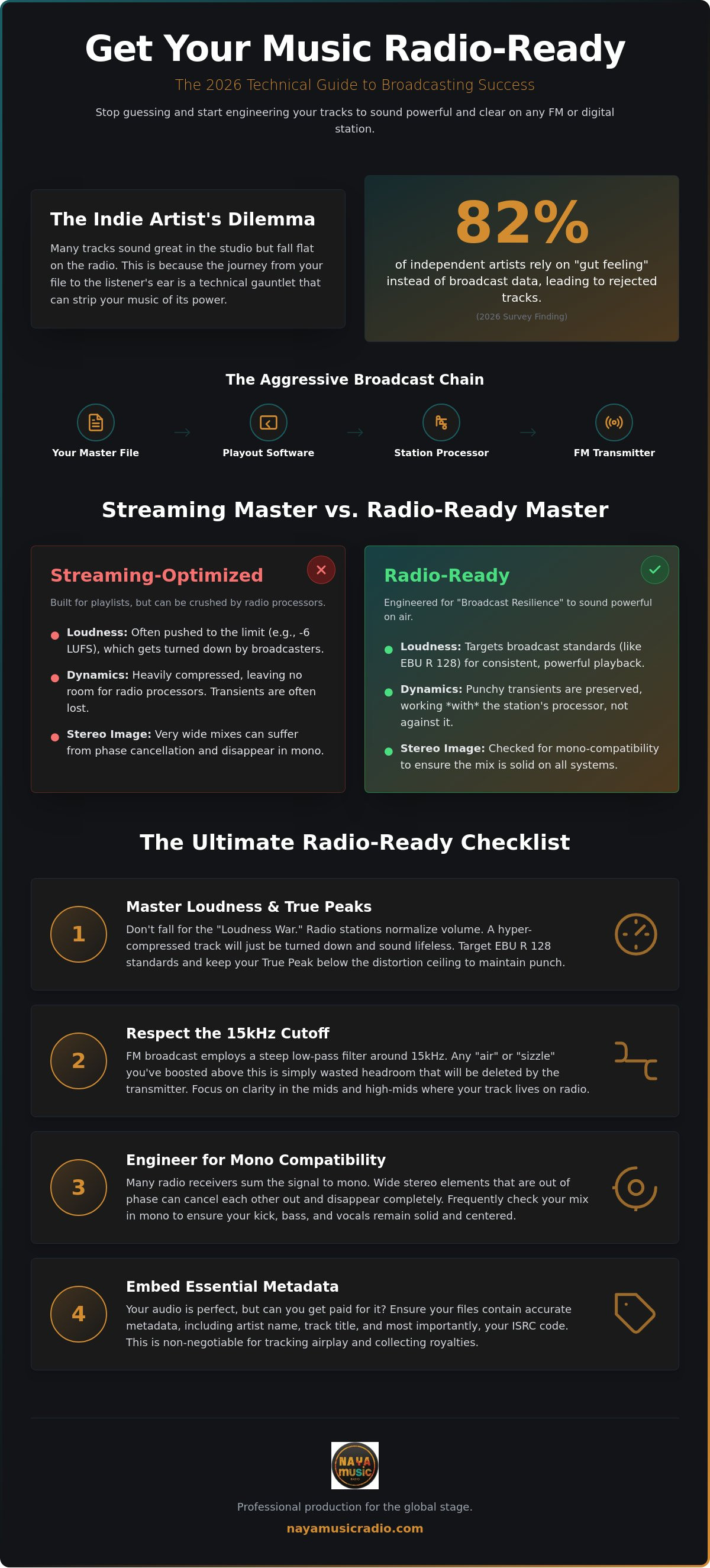
Did you know that a 2026 survey found 82% of independent artists rely on "gut feeling" rather than objective data when preparing their music for the public? This often leads to tracks that sound thin or muddy once they hit the airwaves, making the art of mixing music for radio play more critical than ever for your professional career. You've likely spent weeks perfecting your sound in the studio, yet the fear that a radio programmer might reject your track because it lacks professional "punch" is a heavy burden to carry. It is incredibly frustrating to hear your masterpiece lose its energy the moment it passes through a station's aggressive broadcast processor.
We're here to help you reclaim that power and step onto the global stage with total confidence. This guide will strip away the confusion between streaming LUFS and actual radio standards, ensuring your music sounds massive on every FM and digital station across the UK and beyond. We are breaking down the essential 2026 technical checklist, from mastering the EBU R 128 loudness targets to implementing the metadata requirements that keep your brand visible and your royalties flowing. It's time to stop guessing and turn your creative vision into a frictionless broadcast reality.
Key Takeaways
- Understand how to protect your track's clarity and punch as it passes through the intense broadcast chain.
- Discover the specific frequency and stereo techniques for mixing music for radio play that prevent your sound from getting lost in the mid-range.
- Master the 2026 technical pillars like True Peak ceilings and LUFS targets to ensure your tracks hit hard without distorting.
- Ensure every spin counts by implementing essential metadata and ISRC codes that guarantee you get paid for your airplay.
- Learn why professional studio environments are the key to transitioning from independent creator to a global radio mainstay.
Why Radio Airplay Requires a Different Mastering Approach
Your music is a movement, a cultural contribution that deserves to be heard with total clarity. However, the path from your studio to a listener’s car radio in London is a technical gauntlet. A "Radio-Ready" track is more than just a high quality recording; it is a file engineered to maintain its power and transparency even when pushed through aggressive broadcast limiters. The technical requirements for mixing music for radio play are distinct from those for streaming platforms, requiring a strategic approach to dynamics and frequency balance. If your audio mastering process ignores the specific physics of FM transmission, your track risks sounding thin or distorted on the global stage.
The broadcast chain is a complex sequence that begins with your digital file and ends at the station’s transmitter. Along the way, your audio passes through playout software, digital-to-analog converters, and heavy signal processing designed to keep the station's volume consistent. Many artists discover too late that a master optimized for Spotify fails on FM radio due to phase cancellation. Because many radio receivers sum stereo signals toward mono to maintain a strong signal, wide stereo elements that sound great on headphones can suddenly disappear on the air. This technical failure has a real emotional cost. A track that loses its punch feels amateur, potentially causing radio programmers to skip your submission in favour of something that sounds more robust.
The FM Radio Processor: Your Secret Competitor
Radio stations use multi-band compression to define their "signature sound." They want every track to feel like it belongs to their brand, whether that is a high-energy dance station or a smooth jazz outlet. If your master is already over-compressed, the station's hardware will squash it even further, creating a pumping effect that sounds smaller and more exhausting than a dynamic track. While internet radio allows for more flexibility, traditional FM broadcast standards remain the gold standard for reaching massive local audiences. You aren't just competing with other artists; you're competing with the station’s own processing hardware.
The Loudness War vs. Broadcast Resilience
In 2026, chasing a -6 LUFS master is a losing strategy that actually results in a quieter sound on the airwaves. Modern broadcast processors are designed to normalise volume, meaning they will simply turn down an overly loud track until it fits their internal target. Broadcast Resilience is the ability of a master to retain transient punch after heavy limiting. By leaving room for the station's processors to do their job, you ensure your drums stay sharp and your vocals remain prominent. The industry has shifted toward dynamic range, rewarding artists who prioritise clarity over raw, distorted volume.
The Technical Pillars: How FM Processing Affects Your Sound
To achieve a sound that dominates the airwaves, you must understand the hardware standing between your track and the listener. While streaming services use software algorithms, radio stations rely on heavy-duty hardware processors like Orban Optimod or Omnia units. These machines make every song sound as loud and consistent as possible, but they can be brutal to a poorly prepared mix. When you're mixing music for radio play, you aren't just balancing instruments; you're building a file that can survive these "black boxes" without losing its soul. One of the most significant technical hurdles is the 15kHz low-pass filter used in FM broadcasting. Any high-end "air" or "sizzle" you've boosted at 18kHz is simply discarded. Don't waste your precious headroom on frequencies that the transmitter will eventually delete.
Your drums need to snap. If your mix is already squashed, the radio's multi-band compressor will swallow your transients, leaving your track sounding flat and lifeless compared to the competition. This is where professional insight becomes your greatest asset. If you want to hear how your track stands up before you hit "send," you can try submitting your song for free to see how it translates across a live digital stream. While we focus on the UK market, global standards are often influenced by FCC radio broadcast regulations, which dictate strict technical parameters for signal interference and frequency deviation. These rules mean that if your high frequencies are too hot, the station's processor will aggressively clamp down on your entire mix to stay within legal limits.
Phase Correlation and Mono Compatibility
Many radio listeners are in cars, shops, or workplaces where the audio is effectively mono. If your synth leads or backing vocals rely on extreme stereo width, they might disappear entirely due to phase cancellation. Always check your mix in mono. Use a correlation meter to ensure your low-end stays centered and powerful. If the meter dips into the red, your bass will vanish the moment it hits a mono speaker, leaving your track sounding thin and amateur.
Managing the Low End for Small Speakers
Sub-bass is a headroom killer. While a massive 30Hz kick feels great in a club, it will trigger the radio station’s limiter to "pump" or "breathe" in an unflattering way. Control your low-end with a high-pass filter around 30-40Hz to save energy for the frequencies that actually matter on small speakers. This ensures your vocals sit firmly on top of the beat, maintaining clarity even when the signal is compressed.
The Ultimate Radio-Ready Music Checklist for 2026
Precision is your passport to global airwaves. While the creative side of mixing music for radio play is about vibe and emotion, the final checklist is about cold, hard technical survival. You need to ensure your track doesn't just sound good in your studio, but remains powerful when it hits a DAB+ multiplex or an FM transmitter across various broadcast markets. Start with your True Peak ceiling. Setting this to -1.0 dBTP is the safest bet for 2026. This small amount of headroom prevents clipping when radio stations transcode your audio into various broadcast formats. If you hit 0.0 dBTP, you are leaving your sound at the mercy of cheap digital-to-analog converters.
Next, look at your integrated loudness. Aiming for -12 to -14 LUFS provides the perfect balance of commercial density and dynamic life. If you push much harder, you'll simply trigger the station's AGC (Automatic Gain Control) to turn you down, potentially sucking the life out of your choruses. High-frequency management is also vital. FM radio uses a process called pre-emphasis, which boosts high frequencies to improve the signal-to-noise ratio. This can turn a slightly bright vocal into a sibilant nightmare for the listener. Use a de-esser to tame those "S" and "T" sounds more aggressively than you would for a streaming-only master.
Step-by-Step Export Settings
Professional delivery starts with the right file format. Use uncompressed WAV or AIFF files to maintain every ounce of detail. While 16-bit was the old standard, 24-bit is now the 2026 benchmark for high-fidelity broadcast, providing a superior signal-to-noise ratio. Adhering to these broadcast engineering standards ensures your creative vision survives the technical journey to the listener's ears.
- Sample Rate: Export at 44.1kHz or 48kHz depending on the station's specific submission requirements.
- Dithering: Apply a high-quality dither if you are downsampling from a higher bit depth to prevent quantization distortion.
- Mono Compatibility: Flip your master to mono one last time. If the lead vocal and snare lose their presence, you have phase issues that will ruin the broadcast.
Final Ear Test: The Car Test Reimagined
Before you send your track out, simulate the radio experience. Set up a mastering chain mockup with a multi-band compressor and a fast limiter to see if your mix starts "pumping" in the chorus. If the bass makes the vocals dip, go back to the mix and tighten your low-end. Once you are confident in your technical quality, it’s time to focus on radio airplay for independent artists to get your sound in front of the right programmers. Listen for any harshness in the high-mids that might become fatiguing on a long drive. If your track sounds balanced in a stock car stereo, it's ready for the world.
Beyond the Audio: Metadata and Radio Delivery Standards
Achieving the perfect balance when mixing music for radio play is a massive victory, but your journey doesn't end at the export window. If a DJ cannot find your track in their library or if the station's software can't track your plays, your hard work remains invisible. Professional radio delivery requires a meticulous approach to metadata that turns your audio file into a broadcast-ready asset. This isn't just about organisation; it is about ensuring your movement is documented and your creative efforts are compensated. In the fast-paced world of digital broadcasting, your file needs to be as professional as your sound.
ISRC and Royalty Tracking
An ISRC code is the digital fingerprint of your recording. In the UK, you can obtain these through PPL (Phonographic Performance Ltd), while creators in New York often look to the US ISRC Agency. Without this code, radio stations cannot accurately log your plays for royalty collection societies like PRS for Music or ASCAP. This 12-character alphanumeric string identifies the specific recording, ensuring that every time your track hits the airwaves, the financial rewards find their way back to you. Don't leave your income to chance by skipping this essential step during the final stages of production.
DJ booths are high-pressure environments where seconds count. Help them help you by using clear, logical file naming conventions. Avoid confusing names like "Master_Final_V3_Fixed"; instead, use a standard format such as "ARTIST_NAME - SONG_TITLE (RADIO_EDIT)". Embed ID3 tags that include high-resolution artwork, your contact information, and the genre. This makes your track instantly searchable in a station's digital playout system, significantly increasing the likelihood of a last-minute spin when a producer needs a fresh track to fill a gap.
The Perfect Radio Submission Package
Managing profanity is a non-negotiable part of daytime airplay. A professional clean edit involves more than just bleeping out words; it often requires re-recording specific lines or using creative "reverse" effects to maintain the song's rhythmic flow. Keep the "3-Minute Rule" in mind as well. Radio programmers are often looking for concise, high-energy tracks that fit into tight broadcast windows between news and adverts. Shorter track lengths make your music a frictionless choice for producers looking to maintain a steady tempo.
Including a radio one-sheet with your submission adds a layer of authority to your brand. This document should briefly highlight your recent wins, your social media reach, and a short, punchy description of the track. It provides the presenter with instant "talking points" to introduce your music to their audience. When you're confident that your package is complete, you can submit your song for free to join our 24/7 live stream and start your journey toward global rotation.
Take the Stage: Professional Production at NAYA Music Radio Studios
Your music is part of a global movement, and every movement needs a dedicated home to reach its full potential. While home studios are perfect for capturing the initial spark of inspiration, the technical nuances of mixing music for radio play often demand the refined acoustics and high-end outboard gear found only in a professional environment. Stepping into a world-class studio isn't just about the equipment; it is about surrounding yourself with the energy of a creative hub designed to elevate independent talent. We have established physical studio rentals in major cultural capitals including London, New York, Atlanta, and DC to ensure you have a local destination for global sound. These spaces are engineered to help you transition from a bedroom producer to a broadcast professional.
Our facilities offer more than just a place to record. You gain access to a sophisticated integrated radio rotation ecosystem that bridges the gap between the final master and the first spin. By using high-end outboard processors that mimic the natural warmth of traditional broadcast chains, we ensure your tracks possess the harmonic depth required to stand out on FM and digital waves. When you choose a professional environment, you are investing in the "Broadcast Resilience" we discussed earlier, giving your transients the space they need to breathe even under heavy station limiting. It's the difference between a track that merely exists and one that commands attention the moment the DJ hits play.
Expert Ears in World-Class Hubs
Booking a session at one of our creative hubs puts you in the room with engineers who live and breathe the NAYA Music Radio signal chain. They understand exactly how our processors respond to different frequencies, allowing them to provide a final radio polish that DIY setups often miss. You can collaborate directly with our managers to ensure your track is "Spotlight Ready" from a technical and promotional standpoint. This partnership removes the guesswork, providing you with the confidence that your technical quality meets the highest industry standards before your track ever leaves the building.
The Final Leap: Submit for Free Rotation
Once your track has been refined to perfection, taking the next step is entirely frictionless. You can use our free song submission radio tool to get your music evaluated for our 24/7 live stream. The quality of your mastering directly impacts your chances of being selected for an Artist Spotlight, a platform designed to amplify emerging voices to an international audience. Join the movement and professionalise your sound with NAYA Music Radio. We are here to act as your global stage-builder, turning your creative vision into a powerful broadcast reality that resonates across the world.
Own the Airwaves in 2026
Mastering the technical art of mixing music for radio play is the final bridge between your creative vision and a global audience. By prioritising broadcast resilience over raw loudness and ensuring your metadata is bulletproof, you position your tracks to survive the toughest FM signal chains with their dynamics intact. You have the tools, the checklist, and the technical standards to ensure your sound never loses its punch when it hits the transmitter. Now, it's time to elevate your brand from the bedroom to the professional stage.
We are here to help you scale that mountain with total transparency and high-energy support. With professional studio facilities in London and New York, our integrated artist management and global broadcasting reach provide the ultimate ecosystem for emerging talent. Don't let technical hurdles hold back your movement or your royalties. Ready for the airwaves? Book a session at NAYA Music Studios today! We are ready to champion your sound and provide the professional promotion your music deserves. Your journey to the top of the rotation starts with one bold step. Let's make some noise together.
Frequently Asked Questions
What is the best LUFS level for radio airplay in 2026?
Aim for -12 to -14 LUFS integrated loudness to ensure your track survives the station's signal chain with its dynamics intact. While many streaming platforms target -14 LUFS, radio can handle a slightly denser master, but pushing beyond -10 LUFS often triggers aggressive limiting. This sweet spot allows the broadcast processor to add its signature "glue" without squashing your transients into a flat, lifeless wall of sound.
Do I need a different master for FM radio and Spotify?
You definitely need a tailored approach when mixing music for radio play compared to preparing a track for streaming. FM radio requires a more conservative True Peak ceiling of -1.0 dBTP and much stricter mono compatibility to avoid phase issues during transmission. A master optimised only for Spotify might sound thin or pump unpleasantly once the station's multi-band hardware starts processing the signal.
Can I use AI mastering for radio-ready tracks?
AI mastering services are a fast, affordable option that many independent creators use to get their music onto digital platforms quickly. These tools are excellent for hitting basic loudness targets, but they often lack the nuanced "expert ears" needed to navigate complex broadcast resilience. For a track destined for heavy rotation or an Artist Spotlight, a professional engineer's touch ensures your sound remains professional across all speaker types.
What is an ISRC code and why do I need one for radio?
An ISRC code is the unique digital fingerprint of your specific recording, acting as a permanent identifier for tracking and payments. Radio stations use these codes to log every spin, ensuring that royalty collection societies like PPL in the UK can pay you accurately. Without this code, your track is essentially a "ghost" in the system, making it impossible for you to claim the income your airplay generates.
How long should a radio edit be for daytime rotation?
Most radio programmers prefer tracks that sit between 2:30 and 3:00 minutes for daytime airplay. Shorter lengths make your music a frictionless choice for producers who need to fit tracks into tight broadcast windows between news and adverts. If your original version is longer, creating a concise edit that hits the chorus quickly will significantly increase your chances of being chosen for a playlist.
Why does my bass sound distorted on the radio but fine in my headphones?
Radio processors are extremely sensitive to sub-bass energy that your studio headphones might handle without a struggle. If your low-end isn't controlled with a high-pass filter around 30Hz, those ultra-low frequencies will trigger the station's limiter to clamp down on your entire mix. This creates a muddy, distorted sound because the processor is working too hard to manage energy that most listeners can't even hear.
What file format do radio stations prefer for broadcast?
Broadcast professionals almost exclusively require uncompressed WAV or AIFF files at 24-bit resolution for the highest possible fidelity. Ensure your sample rate is set to 44.1kHz or 48kHz depending on the specific station's submission guidelines. Sending high-quality, uncompressed files prevents your music from degrading further when the station converts it into various digital broadcast formats for DAB+ or web streams.
Is mono compatibility still important for modern digital radio?
Mono compatibility remains vital because a huge percentage of listeners still hear your music through car radios, shop speakers, or mono-summed digital devices. If your mix relies on extreme stereo width without a solid centre, your lead vocals or snare could vanish entirely when the signal is summed. Always check your correlation meter to ensure your sound is powerful and consistent, regardless of the listener's playback environment.