
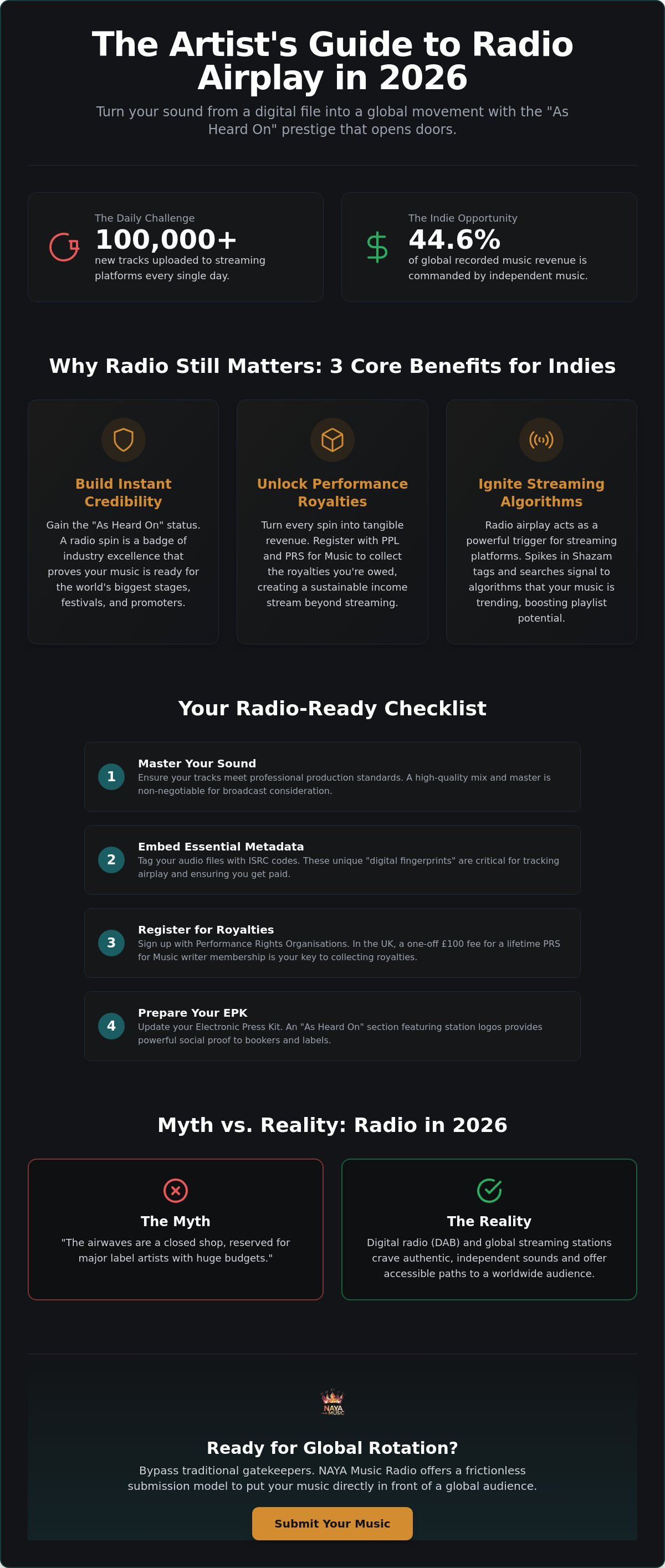
Over 100,000 new tracks are uploaded to streaming platforms every single day, yet independent music now commands a massive 44.6% share of the global recorded music revenue. You know your sound belongs on the big stage, but the path to getting there often feels blocked by technical jargon and expensive gatekeepers. It is exhausting to pour your heart into a record only to feel invisible once it hits the web. You deserve more than a digital play button; you want the prestige of a global broadcast and the "As Heard On" status that validates your brand for festivals and fans alike.
We are here to bridge that gap and champion your sound. This guide reveals the definitive 2026 strategy for securing radio airplay for independent artists, showing you how to navigate the UK market and international rotations without the confusion. You will discover how to earn the performance royalties you are owed through PPL and PRS for Music while transforming your tracks into a global movement. We are breaking down the technical requirements and showing you how to build a frictionless path to the airwaves, ensuring your music finds the global audience it was always meant to reach.
Key Takeaways
- Identify the most accessible entry points for your sound by understanding the distinct roles of FM, DAB, and global digital streaming in 2026.
- Turn every spin into tangible revenue by mastering the registration process with PPL and PRS for Music to collect your performance royalties.
- Secure radio airplay for independent artists by ensuring your tracks meet professional production standards and include essential ISRC metadata.
- Build instant "As Heard On" credibility to elevate your brand and prove your music is ready for the world’s biggest stages.
- Discover how to bypass traditional gatekeepers using frictionless submission models that put your music directly in front of a global audience.
The Reality of Radio Airplay for Independent Artists in 2026
Radio has evolved into a high-octane engine for discovery. It is no longer just about a local FM tower; in 2026, The Reality of Radio Airplay encompasses a massive network of DAB frequencies and 24/7 global digital streaming. This ecosystem acts as the ultimate filter in a world where over 100,000 tracks drop daily. When a professional DJ selects your record, they aren't just playing a song. They are awarding you a badge of industry excellence. This human curation remains the premier gatekeeper for credibility because it provides a level of trust that a machine-generated playlist cannot replicate.
Don't view radio and streaming as rivals. They are partners in a larger movement. Securing radio airplay for independent artists often acts as the spark that ignites streaming algorithms. When a listener hears your track on the air, they search for it on platforms like Spotify or Apple Music. This surge in high-intent searches tells the algorithms that your music is trending, which can lead to placement on major editorial playlists. It's a cycle of visibility that builds your brand across every digital platform simultaneously.
Myth vs. Reality: Is Radio Still Relevant?
Many creators believe the myth that the airwaves are reserved for major label stars with deep pockets. That is simply not true. While daytime FM rotation is competitive, the rise of specialist shows and digital hubs has opened the doors wide for unsigned talent. These platforms crave authenticity and fresh sounds. Securing a spot on these shows provides an "Authority Factor" that boosts your professional profile. It proves to the industry that you have a sound that resonates with professional curators, helping you stand out in a crowded market.
The 'As Heard On' Effect for Your EPK
Your Electronic Press Kit (EPK) is your passport to the global stage. Including an "As Heard On" section with reputable radio logos creates instant trust with promoters and venue owners. If you want to book a headline slot in London or a showcase in Manchester, showing that you have already secured radio airplay for independent artists on a global scale is a massive advantage. It changes the conversation from "Who are you?" to "When can you play?". Beyond the industry, it creates a sense of pride within your fanbase. Seeing their favourite artist transition from a bedroom studio to a global broadcast turns casual listeners into dedicated advocates for your movement.
Why Radio Still Matters: The 3 Core Benefits for Indies
Radio is the ultimate validator. While a million streams look good on a dashboard, a single radio spin resonates with a different kind of authority. It is about global connectivity. You could be recording in a studio in London while a DJ in Atlanta introduces your sound to thousands of new ears. This human curation creates a deep sense of audience trust. Listeners know that a professional has filtered through the noise to find your track, which carries more weight than a random algorithmic suggestion. It turns your music into a shared experience rather than a solitary stream.
Securing radio airplay for independent artists also triggers a "long-tail" effect for your brand. When a track hits the airwaves, you'll often see a corresponding spike in Shazam tags and digital service provider (DSP) streams. This happens because radio reaches people in their cars, offices, and gyms; places where they aren't actively scrolling but are primed for discovery. These spikes provide the data you need to prove your music has "legs" to promoters and labels alike.
Performance Royalties and Revenue Streams
Every spin is a revenue event. To capture this, you must understand the technical side of the industry. Navigating the Airwaves requires a solid grasp of how royalties function for independent creators. Your ISRC codes act as digital fingerprints, ensuring that performance rights organisations like PPL and PRS for Music can track your usage. In the UK, a lifetime writer membership with PRS for Music costs a one-off fee of £100. Once you're registered, you can tap into quarterly distributions. For example, PPL's main annual payment for 2025 airplay is scheduled for 30 June 2026. This tangible income often proves more substantial than the fractions of a penny earned from standard streaming plays.
Social Media Amplification for Artists
The real magic happens when you merge the airwaves with your social strategy. Radio play is a content goldmine. Don't just let the moment pass. Record yourself hearing your song on the radio for the first time; these reaction videos are high-energy assets for TikTok and Reels. You can also use snippets from radio interviews as authoritative "hooks" to grab attention in your bio. Radio provides the proof of work social algorithms love. It transforms your music from a digital file into a verified cultural moment. If you're ready to start this journey, you can submit your track for free to begin building your global presence.
Navigating the Airwaves: Digital Radio vs. Traditional FM
Choosing where to pitch your music is a strategic decision that defines your trajectory. Traditional FM radio remains a prestigious target, but it often feels like a fortress with high walls. Gaining rotation on major FM stations typically requires a professional radio plugger. These industry specialists act as the middleman, but their services often cost hundreds or even thousands of pounds for a single campaign. While this path can lead to national recognition, the barrier to entry is steep for those just starting out. It is a high-stakes game that demands a significant budget and a proven track record.
Digital radio has completely rewritten the rules. It provides a frictionless entry point that values sound over status. For many, securing radio airplay for independent artists begins with stations that live in the digital space. These platforms aren't limited by signal range or geographical borders. They offer 24/7 global reach, allowing your music to travel from a bedroom in Bristol to a car in Washington DC instantly. This is the new frontier of music discovery, where niche genres find dedicated homes and global movements are born.
The Rise of Global Digital Hubs
Stations like NAYA Music Radio are more than just broadcasters; they are global stage-builders. By offering 24/7 live radio streaming, these hubs bridge the gap between local scenes and international audiences. This constant presence is vital for growth. Digital stations often boast higher per-listener engagement because their audiences are specifically seeking out new sounds rather than passive background noise. How to Get Your Track Radio-Ready involves understanding that these listeners are active participants in your journey, frequently transitioning from a radio spin to a social media follow.
Plugging vs. Direct Submission
The traditional plugging model is effective but can be a financial drain. Campaigns can easily exceed £500 for just a few weeks of promotion, with no guarantee of airplay. In contrast, the modern "frictionless" path focuses on direct connection. Platforms offering song submission for free remove the financial risk, allowing you to test your material on a global stage without breaking the bank. Before you submit, always vet the station. Look for active social amplification and a transparent artist spotlight programme. You want to join a community that celebrates your creativity, not just a station that fills a time slot. This shift toward direct submission is democratising the airwaves, ensuring that the best music wins, regardless of the label behind it.
How to Get Your Track Radio-Ready: A Practical Checklist
Success on the airwaves starts long before the DJ hits play. To secure radio airplay for independent artists, your music must meet the rigorous technical and creative standards of professional broadcasting. It is about presenting a package that is impossible to ignore. If your track sounds like a demo, it won't make the cut, regardless of how good the songwriting is. Professional mixing and mastering are your entry tickets to the global stage. You want your sound to feel at home next to the biggest names in the industry.
- Step 1: Professional Production. Ensure your track is balanced and punchy. It needs to hold its own against major label releases in terms of loudness and clarity.
- Step 2: Metadata and ISRC Codes. Embed your ISRC codes directly into your files. This ensures PPL can track your spins so you can collect the royalties we discussed earlier.
- Step 3: The Radio Edit. Aim for a length between 2:30 and 3:30 minutes. Place your hook within the first 30 seconds to capture the listener's attention immediately.
- Step 4: The 'Artist Spotlight' Story. Give the DJ a reason to champion you. They need a narrative to share with their audience during the transition between tracks.
- Step 5: High-Res Assets. Provide a professional press photo and your social media handles. This makes it frictionless for the station to tag you in their digital promotion.
Technical Requirements for Airplay
Station producers are busy. They want files that work instantly without extra editing. While high-quality MP3s (320kbps) are sometimes accepted, most professional stations in 2026 prefer 24-bit WAV files for their superior depth and clarity. Always include a "Clean Version" of your track. Compliance with Ofcom regulations in the UK is mandatory for daytime broadcast. If your track contains explicit language, it'll be rejected immediately unless you provide a radio-safe edit. Ensure your metadata is "read-only" so station logs can automatically capture your artist name and track title for their digital displays.
Crafting Your Pitch for Radio Rotation
Your email subject line is your first impression. Use a "No-Nonsense" format like: [Artist Name] | [Track Title] | [Genre] | [Location]. This helps producers categorise your music at a glance. If you have a local connection to major music hubs like London, Atlanta, or New York, mention it early. This helps you gain local favour and shows you're part of a wider cultural movement. The Artist Spotlight is a high-impact, 30-word pitch that distils your unique sound, recent achievements, and cultural influence into a single, compelling narrative that demands a DJ’s immediate attention. When you're ready to take the next step, you can apply for an Artist Spotlight to get your music the global visibility it deserves.
NAYA Music Radio: Your Frictionless Path to Global Rotation
NAYA Music Radio isn't just a broadcaster; it's a dedicated global stage-builder designed for the modern era. We've seen how the traditional industry can feel like a closed shop, so we've built a home that prioritises creativity over corporate backing. Our mission is to provide a launchpad where your sound can resonate across borders without the typical friction. By securing radio airplay for independent artists through our platform, you're joining a movement that celebrates authenticity and rewards professional excellence. We provide the infrastructure you need to transition from a local creator to a global contender.
We believe that high-quality music deserves to be heard regardless of the artist's budget. That's why our model for song submission for free is a core part of our identity. It removes the financial barriers that often prevent unsigned talent from reaching the airwaves. Every track submitted is reviewed by our team of curators who are deeply embedded in the culture. This ensures that our 24/7 live radio streaming remains a vibrant hub for discovery, offering listeners a curated experience they won't find on a generic, machine-led playlist.
Why NAYA is the Home for Emerging Talent
Our reach extends far beyond a single frequency. We provide a 24/7 broadcast that connects major music markets, ensuring your music is heard in hotspots like London, Atlanta, and Washington DC. But we don't stop at the spin. Our "Interview + Social Amplification" package is designed to make your story go viral. We take the highlights of your journey and turn them into high-authority content for your social channels, providing the "proof of work" that attracts new fans and industry professionals. We act as the essential bridge, taking the energy of your local scene and presenting it to an international audience that is ready to support your growth.
Beyond the Airwaves: Studio and Management
Getting that "radio-ready" sound often requires more than just talent; it requires the right environment. We offer physical studio rentals in London and Atlanta, providing independent creators with access to world-class recording spaces. These studios are the heart of our ecosystem, where tracks are polished to meet the high standards we've discussed. For those ready to scale their careers even further, our music distribution and artist management services provide a professional framework for long-term success. We are here to guide you through every stage of your development, from your first radio spin to managing a global brand. Join the movement and submit your song for free rotation today!
Launch Your Sound Onto the Global Stage
The airwaves are no longer a gated community for the few; they are a vibrant, global stage waiting for your unique sound. By mastering technical requirements and leveraging digital hubs, you transform your tracks from digital files into cultural movements. You've learned that radio is the ultimate trust signal, a royalty generator, and the spark that ignites streaming algorithms. Now is the time to move from the bedroom to the broadcast.
We are redefining independent artist exposure by removing the old barriers to entry. With 24/7 global live streaming and professional physical studios in London, New York, and Atlanta, we provide the infrastructure to turn your ambition into rotation. Securing radio airplay for independent artists has never been more accessible or more vital for building a lasting brand. Take the leap and join a community that champions emerging talent on a worldwide scale.
Submit your music to NAYA Music Radio for free rotation! Your global audience is already listening.
Frequently Asked Questions
How do independent artists get played on the radio for free?
You can secure radio airplay for independent artists for free by targeting stations with open submission policies, such as BBC Introducing or community digital hubs. Many stations offer a frictionless path for unsigned talent to upload tracks directly to their curators. Focus on stations that champion your specific genre or cultural movement. This approach removes the need for expensive middle-men and lets your sound speak for itself on a global stage.
Do I need a radio plugger to get my music on the airwaves?
You don't necessarily need a radio plugger to reach a global audience, especially with the rise of digital broadcasting. While pluggers have established relationships with daytime FM DJs, their fees can be a significant hurdle for independent creators. Many artists now find success through direct submission models and grassroots digital stations. These platforms often prioritise fresh, authentic sounds over label backing, making the airwaves more democratic than ever before.
What is the difference between a radio spin and a streaming play?
A radio spin is a curated broadcast to a wide audience, while a streaming play is an individual, on-demand event. When a DJ plays your track, it reaches thousands of listeners simultaneously, providing a "trust signal" that individual streaming lacks. Radio plays also trigger different royalty streams through PPL and PRS for Music. This combined reach builds brand credibility and connects you with a community of listeners in a single, shared moment.
How long should a song be for radio rotation?
The ideal length for a radio edit is typically between 2:30 and 3:30 minutes. Stations need to manage tight schedules and ad breaks, so shorter tracks are often easier to slot into rotation. Ensure your track has a strong hook that appears within the first thirty seconds to keep listeners engaged. If your original version is longer, creating a dedicated radio edit is a smart move to increase your chances of airplay.
Can I get radio airplay with a home-recorded track?
Yes, you can get radio airplay with a home-recorded track as long as it meets professional mixing and mastering standards. In 2026, the technology available to independent creators means high-quality production is possible outside of expensive commercial studios. However, the sound must be "radio-ready" to compete with major label releases. If your production is balanced and clear, curators will focus on the quality of the song rather than the location of the recording.
What are ISRC codes and why do I need them for radio?
ISRC codes are unique digital fingerprints that identify your sound recordings, ensuring you get paid for every spin. These codes allow performance rights organisations like PPL to track your radio airplay for independent artists and distribute the royalties you've earned. Without them, your music is essentially invisible to the automated logging systems stations use. Always embed these codes in your metadata before submitting your music to any professional broadcaster.
How do I turn a radio interview into social media content?
Transform your radio interview into high-impact social content by filming the session or using audio snippets as "hooks" for TikTok and Reels. These clips act as authoritative proof of your work and build instant trust with new followers. You can also create reaction videos or share behind-the-scenes footage from the studio. This strategy amplifies your broadcast reach and keeps your audience engaged long after the live interview has ended.
Does NAYA Music Radio accept all genres for submission?
We welcome a diverse range of sounds and cultural movements at NAYA Music Radio. Our platform is designed as an inclusive global hub where emerging talent from all genres can find a stage. Whether you're producing drill, afrobeat, or alternative sounds, we want to hear your most authentic work. Our curation team focuses on the quality of the production and the strength of your artist story to build a vibrant, global community.


