
A music manager isn't a rescue boat sent to save a stalling career; they are the high-octane fuel for an engine that's already roaring. You've likely spent countless nights buried in spreadsheets and social media admin, feeling like the London-centric industry is a private club you haven't been invited to join. It's exhausting to act as the CEO, the creative, and the booking agent all at once while trying to keep your music authentic. Finding a professional music manager for independent artists UK who matches your drive is the essential step to reclaiming your creativity and scaling your sound.
This guide provides a clear, actionable roadmap to identifying and attracting the right partner to lead your team. You'll discover how to look professional to industry scouts, understand the crucial differences between a manager and an agent, and learn the 2026 standards for fair representation. We are stripping away the gatekeeper myths to help you build a movement that resonates across global stages and secures your place in the spotlight. Whether you're navigating the new 2026 government music strategies or looking to break out of your local scene, this is your blueprint for professional growth.
Key Takeaways
- Redefine your partnership by understanding how a modern manager acts as your brand strategist and business architect to navigate the 2026 industry landscape.
- Audit your "manageability" to ensure your digital footprint and streaming momentum are strong enough to attract high-level scouts.
- Streamline your search using professional resources like the MMF directory to find vetted partners who align with your specific sound and creative goals.
- Master the professional pitch to a music manager for independent artists UK by using low-friction communication strategies that showcase your best work instantly.
- Build essential "proof of concept" data through global radio airplay and professional studio recordings to prove your career is ready to scale.
What Does a Music Manager Do for UK Independent Artists?
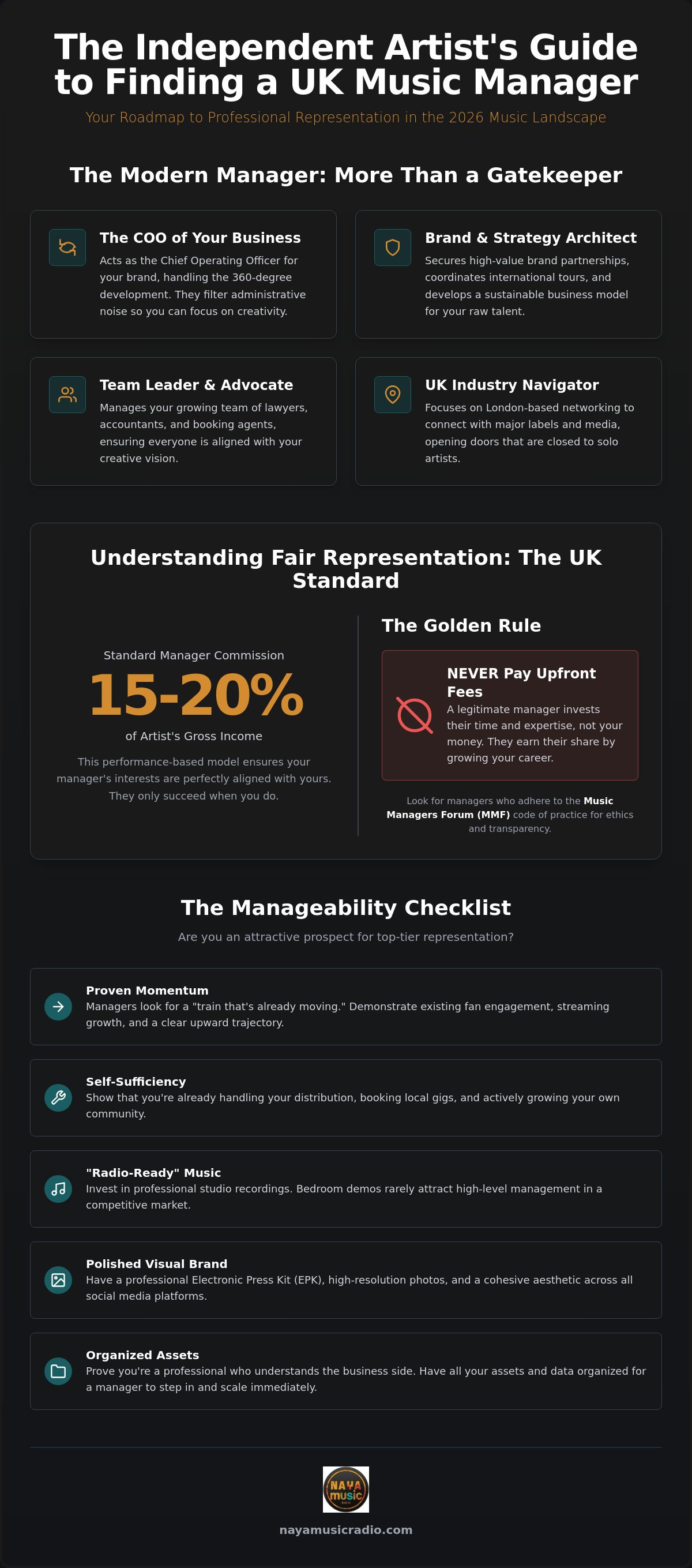
A music manager is much more than a gatekeeper; they are the engine room of your professional career. While you focus on the rhythm and the lyrics, your manager handles the 360-degree development of your brand. This includes everything from securing high-value brand partnerships to coordinating complex international tour logistics. Finding a music manager for independent artists UK means securing a partner who understands the pulse of the global industry while keeping a sharp eye on your local growth. Succeeding in the UK market requires a specific focus on London-based networking, as the capital remains the central hub for major label headquarters and influential media outlets. You might work with an individual day-to-day manager who offers personalized attention, or a larger strategic management company that provides a broader suite of resources and industry leverage.
The COO of Your Music Business
Think of your manager as the Chief Operating Officer of your brand. By filtering out the administrative noise, they allow you to stay in the creative flow without worrying about contract fine print or scheduling conflicts. As your career scales, they manage your growing team of lawyers, accountants, and booking agents to ensure everyone is aligned with your vision. A music manager acts as the vital bridge between your creative art and the complex world of global commerce. Understanding What is a Music Manager? helps you realize they are your advocate in every room you haven't entered yet. They transform your raw talent into a sustainable business model by opening doors that remain closed to solo artists.
UK Industry Standards and Commissions
Transparency is the foundation of a successful partnership. In the UK music industry, the standard commission rate for a manager is typically between 15% and 20% of an artist's gross income. This performance-based model ensures your interests are perfectly aligned; they only succeed when you do. You should always look for professionals who adhere to the Music Managers Forum (MMF) code of practice, which sets the benchmark for ethics and transparency. One golden rule remains absolute: you should never pay a manager an upfront fee or a monthly retainer. A legitimate music manager for independent artists UK invests their time and expertise into your potential, not your bank account. They earn their share by increasing the size of the whole pie, ensuring that your financial growth outpaces the cost of their representation.
The "Manageability" Checklist: Are You Ready for Representation?
Top-tier representation isn't a prize for having potential; it's a partnership offered to those who have already built a foundation of momentum. In the fast-paced 2026 landscape, a music manager for independent artists UK looks for a train that's already moving. They aren't looking to build your career from scratch. Instead, they want to amplify the success you've already started to generate. Talent is your entry ticket, but manageability is what gets you signed. You need to prove that you are a professional who understands the business side of the industry, from consistent social engagement to a polished digital footprint that speaks for itself.
Managers prioritize artists who demonstrate a high level of self-sufficiency. If you're already handling your distribution, booking local gigs, and growing a dedicated community, you become an attractive prospect. They want to see that you've invested in your own growth before asking them to invest their time and reputation. This means having your assets organized and your brand identity clearly defined so a manager can step in and start scaling immediately without having to fix basic professional gaps.
Your Professional Portfolio
Your audio and visual assets are the first things a manager will scrutinize. While DIY culture is celebrated, "bedroom demos" rarely attract high-level UK management in a competitive market. To be taken seriously, you must invest in professional recording studio rental UK to ensure your tracks meet industry standards. A manager needs to hear "radio-ready" quality that can compete on global playlists. Alongside your music, you need a clear visual brand. This includes high-resolution press photos, a cohesive aesthetic across social platforms, and a professional electronic press kit (EPK) that tells your story with impact and clarity.
Proof of Traction
Numbers don't tell the whole story, but they provide the "proof of concept" managers need to see. Consistent growth on platforms like Spotify and Apple Music shows that your sound resonates with a real audience. Beyond digital stats, a history of live performances in grassroots venues proves you can command a room and build a local fanbase. Industry veterans, many of whom are part of the Music Managers Forum (MMF), look for validation from external sources like radio airplay. Having your tracks spun on professional stations acts as a powerful endorsement of your sound's commercial viability. If you want to start building that essential airplay data today, you can explore global radio rotation opportunities to show managers you're already on the map.
Where to Find and Research Music Managers in the UK
Finding the right music manager for independent artists UK is a mission of precision. You aren't just looking for a professional; you're looking for a partner whose existing network matches your specific genre and ambitions. The UK music scene is a tightly knit ecosystem where reputation is currency. To find a legitimate partner, you must move beyond social media "hype" and look into the official organizations that govern the industry. This proactive research ensures you align with someone who respects the rules of the game and has the connections to move your career forward. Whether you are looking for a boutique specialist or a larger firm, your search begins with verified data and strategic networking.
Top UK Management Directories
The most reliable starting point is the Music Managers Forum (MMF). This is the primary trade body for managers in the UK. By searching their directory, you can find professionals who adhere to a strict code of ethics. For 2026, MMF membership tiers include Emerging Managers at £60 plus VAT, Standard at £120, and Pro at £250 per year. These fees indicate a level of professional commitment you won't find on a random Instagram DM. You should also utilize The Unsigned Guide, which allows you to filter management listings by genre and geographic location. To verify legitimacy, cross-reference potential names with member lists from BPI or UK Music. A boutique manager might offer more hands-on attention, while a major management group provides massive industry leverage. Choose the one that fits your current scale.
The "Similar Artist" Strategy
One of the most effective ways to find a manager is to reverse-engineer the success of your peers. Look at the "About" section of artists who share your sound on Spotify or Apple Music. Often, management contact details are listed directly for booking and sync inquiries. Track who is getting mentioned in industry-leading publications like Music Week or NME. These "credits" tell you who is currently "building" talent rather than just maintaining established stars. You want a manager who is hungry to grow a movement, not one who is too busy with arena-level clients to answer your calls. Check if they are registered with collection societies like PRS for Music or PPL, as this confirms they understand the vital flow of UK royalties.
Physical networking remains a powerhouse in the UK. Attending industry hubs like The Great Escape in Brighton or London-based showcases provides face-to-face access to the people behind the brands. Use LinkedIn to map out the management landscape by following the career paths of successful UK independent artists. This digital and physical "detective work" reveals the hidden connections that drive the industry. By showing up where the professionals are, you prove that you are serious about your business, making you a much more attractive prospect when you finally make your move.
How to Pitch to a UK Music Manager: The Professional Approach
Approaching a music manager for independent artists UK requires a mindset shift from "please notice me" to "let's build something together." Your pitch is the first demonstration of your professional standard. Managers are often overwhelmed with generic, copy-paste messages that offer no specific value. To stand out, you must be the most organized and respectful person in their inbox. This means keeping your initial contact short, punchy, and focused on the momentum you've already generated. By presenting yourself as a business-ready creator, you make it easy for a busy professional to say yes to a conversation.
The golden rule of pitching is to provide a frictionless experience. Never send MP3 attachments or large files that clog an inbox; these are often flagged as security risks or simply ignored. Instead, provide low-friction links to your best work using private SoundCloud links or unlisted YouTube videos. Ensure your best track is the first thing they hear. If they have to click more than twice to find your music, you've already lost their attention. Your goal is to showcase your "radio-ready" sound instantly, proving that you've already invested in high-quality production before seeking their help.
The Perfect Pitch Email Template
Your subject line is your first hurdle. Avoid vague titles like "Music Submission" and opt for something that highlights a recent win, such as "Artist Name; 50k Streams; Recent BBC Introducing Support." This immediately signals that you have traction. Within the body of the email, get straight to the point. Mention a specific artist on their roster you admire to show you've done your homework. Personalizing your message proves that you value their specific expertise rather than just hunting for any industry contact you can find. Close with a clear, low-pressure "Ask," such as a 15-minute introductory call to discuss your upcoming release schedule.
Common Pitching Mistakes to Avoid
First impressions are permanent in the UK music scene. Sending unfinished demos or poor-quality recordings is the fastest way to be labeled as an amateur. If the music isn't ready, the pitch isn't ready. Another common pitfall is acting entitled to a manager's time. Remember that a manager is an investor of their own time and reputation; they owe you nothing until a contract is signed. Finally, failing to explain why you want that specific manager shows a lack of strategy. If you can't articulate why their network is the right fit for your sound, they won't be able to either. To ensure you have the professional data needed to impress, you can start building your global airplay stats today to show managers you are already a developing force.
Following up is an art form. If you haven't heard back after your initial pitch, wait exactly two weeks before sending a polite, one-sentence nudge. Persistence shows drive, but pestering shows a lack of awareness. If they don't respond after a second follow-up, it’s time to move on and focus on building more momentum. The right music manager for independent artists UK will eventually find you if your numbers and sound are impossible to ignore.
Build Your Foundation with NAYA Music Radio
Securing a music manager for independent artists UK is only half the battle; the other half is becoming the artist that a professional manager cannot afford to ignore. Management scouts look for "proof of concept" before they ever commit their time or reputation to a new project. They want to see that you've already invested in your own success. NAYA Music Radio acts as your strategic partner by providing the high-level tools you need to build that essential momentum. From professional studio space to global airplay data, we help you bridge the gap between a talented creator and a business-ready brand.
Our 24/7 live streaming platform offers more than just exposure; it provides the hard data that managers love to see in a pitch. When you utilize our free song submission radio, you aren't just getting your music heard; you're building a track record of global rotation. This airplay acts as a powerful validator, showing industry leaders that your sound is ready for a wider stage. Combined with our Artist Spotlight features, we help you create a "press-ready" image that makes you stand out in a crowded inbox. By leveraging NAYA’s global distribution services, you demonstrate a clear professional intent that separates you from the casual DIY crowd.
From DIY to Managed: The NAYA Roadmap
Transforming your career from a solo effort into a managed operation requires a methodical approach. We've designed a frictionless roadmap to help you navigate this transition with confidence:
- Step 1: Record Professional Tracks. Ditch the bedroom demos and use our high-end London studios to create a polished, "radio-ready" sound that meets 2026 industry standards.
- Step 2: Secure Your Airplay. Build your digital footprint by getting radio airplay for independent artists, giving you the "proof of traction" managers demand.
- Step 3: Pitch with Confidence. Use your NAYA stats, studio-quality recordings, and distribution data to approach the UK’s top managers as a professional peer rather than an outsider.
Join the Movement
NAYA is more than a service provider; we are a "global stage-builder" dedicated to emerging UK talent. We believe in removing the friction between the studio and the airwaves, ensuring that your music has the best possible chance to resonate with international audiences. By joining our community, you gain access to a supportive ecosystem that understands the complexities of digital promotion and artist development. Don't wait for a manager to find you in the noise. Build a movement that is impossible to miss and take control of your creative destiny. Submit your music to NAYA Radio today and start building the foundation your music manager for independent artists UK is looking for.
Take Charge of Your Professional Movement
You now have the roadmap to transition from a solo creator to a managed powerhouse. By auditing your manageability, researching through vetted directories, and mastering the professional pitch, you've removed the barriers that keep most artists in the shadows. Success in the 2026 industry isn't about luck; it's about building a business that's too loud to ignore. Finding the right music manager for independent artists UK is the ultimate catalyst for your career, but that partnership starts with the foundation you build today.
NAYA is here to ensure you don't walk that path alone. We provide the 24/7 global radio exposure and professional London studio access you need to prove your commercial viability to high-level scouts. Our strategic artist spotlight packages are designed to turn your raw potential into a press-ready brand. Build the momentum managers want—Submit your music to NAYA Radio. Your sound belongs on the world stage. Start building your foundation today and watch the industry doors swing open.
Frequently Asked Questions
Do I really need a music manager as an independent artist in 2026?
You only need a manager when the business side of your career begins to overshadow your creative output. In 2026, many artists self-manage until they reach a tipping point of daily admin and complex contract negotiations. A music manager for independent artists UK steps in to scale your existing momentum, not to build it from zero. If you can still handle your own bookings and promotion, focus on building your foundation first.
How much does a music manager typically cost in the UK?
UK managers typically earn a commission of 15% to 20% of an artist's gross income. This performance-based model ensures your goals are perfectly aligned; they only make money when you do. Some modern deals in 2026 use a sliding scale where the percentage decreases as your earnings hit specific milestones. You should never pay a monthly retainer or upfront fees to a legitimate management partner.
What is the difference between a music manager and a booking agent?
A manager oversees your entire career strategy while a booking agent focuses exclusively on securing live performances and tours. Your manager acts as the CEO of your brand, handling everything from label negotiations to social media strategy. In contrast, the agent's job is to route shows and negotiate fees with promoters. Both are vital, but the manager is your primary day-to-day business partner.
Can I get a music manager if I haven’t released any music yet?
It is very difficult to secure management without a track record of released music and existing traction. Managers are looking for "proof of concept," which means they want to see how an audience reacts to your sound before they invest their time. Use platforms like NAYA to build your airplay data and streaming numbers first. This creates the manageability that makes you an attractive prospect for a music manager for independent artists UK.
How do I know if a music manager is legitimate?
Legitimacy is marked by transparency, a solid reputation, and membership in professional bodies like the Music Managers Forum (MMF). A real manager will never ask for money upfront to sign you or promise "guaranteed" stardom. Check their current roster and speak to other artists they represent to verify their work ethic. If they have no verifiable success stories or industry connections, you should proceed with caution.
Should I sign a long-term management contract immediately?
You should ideally start with a trial period of three to six months before committing to a multi-year deal. This "honeymoon period" allows both parties to see if the working relationship is productive and healthy. When you do sign, ensure the contract includes a sunset clause, which in 2026 typically lasts 18 to 24 months. This protects your future earnings by limiting how long a manager collects commission after you part ways.
Does a music manager help with getting my music on Spotify?
While managers don't physically upload your music, they are essential for the strategic pitching that gets you on major playlists. They work closely with your distributor to ensure your release is visible to editorial teams and curators. A manager helps craft the narrative around your release to maximize its digital impact. They ensure your professional distribution and promotion are working as hard as possible for your global growth.
Where are most music managers located in the UK?
London remains the primary hub for the UK music industry, housing the majority of management companies and major label headquarters. However, vibrant scenes in Manchester, Birmingham, and Glasgow are producing world-class professionals who specialize in regional movements. While being near London helps with networking, a great music manager for independent artists UK can effectively lead your team from any city with a strong digital connection and local scene.