
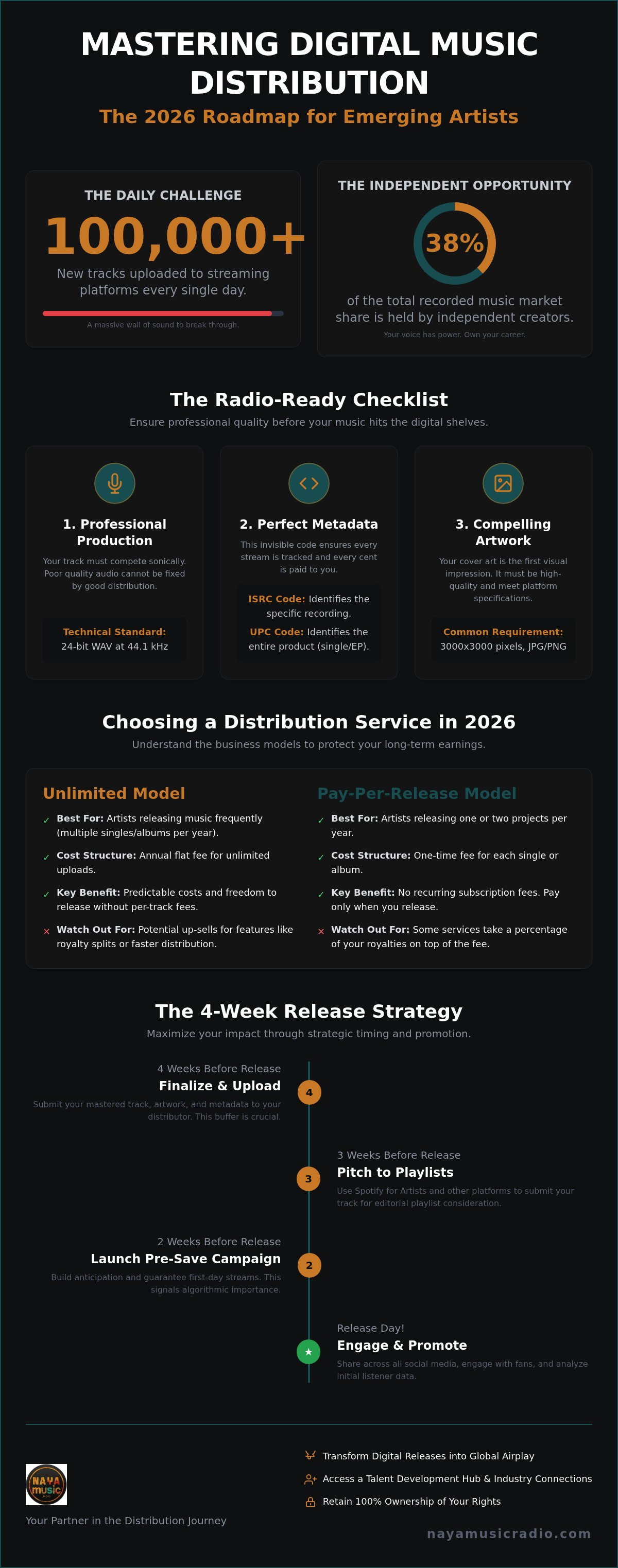
Over 100,000 new tracks are uploaded to streaming platforms every single day. That is a massive wall of sound to break through when you are just starting out. It is easy to feel like your voice is getting lost in a digital ocean where the only thing growing is the list of hidden fees in your distribution contract.
You have likely felt the sting of tracks sitting at zero streams or the headache of trying to decode ISRC metadata on your own. Effective music distribution for emerging artists should not feel like a gatekept secret. We believe your bedroom recordings are the seeds of a global movement, and you deserve a transparent partner to help them bloom. This guide provides a clear roadmap to mastering the 2026 digital landscape while retaining 100% ownership of your rights.
We are moving beyond simple uploads to show you how to build a foundation for radio airplay and international visibility. You will learn to navigate the logistics of major platforms and transform your creative output into a sustainable career. Let's turn your digital files into a global stage.
Key Takeaways
- Understand the 2026 aggregator landscape and define music distribution for emerging artists as the essential bridge to global streaming platforms.
- Use our radio-ready checklist to ensure your audio quality meets professional standards before your tracks hit the digital shelves.
- Compare unlimited versus pay-per-release business models to avoid hidden fees and protect your long-term royalty earnings.
- Master the four-week release strategy to maximize your impact through strategic pre-save campaigns and algorithmic discovery.
- Leverage NAYA Music Radio as a talent development hub to transform your digital releases into global airplay and authentic industry connections.
What is Music Distribution for Emerging Artists?
The old music industry was a fortress with high walls and very few keys. Today, those walls have crumbled. Music distribution for emerging artists is the vital bridge that spans the gap between your finished master recording and the world’s biggest digital streaming platforms. In the 2026 economy, this process is managed by an "aggregator." Think of the aggregator as your digital logistics partner. They take your audio files, verify your metadata, and ensure your music lands exactly where it needs to be across the globe.
Historically, the role of a record label was to handle the physical manufacturing and shipping of vinyl or CDs. If you weren't signed, your music simply stayed in the basement. Now, the shift from physical record stores to digital streaming has democratized the entire industry. Independent creators hold 38% of the total recorded music market share as of 2026. Modern music distribution for emerging artists is about more than just accessibility; it is about ownership. You no longer need to wait for permission to be heard. You are the protagonist of your own career, and distribution is the engine that drives your global reach.
The Role of Digital Streaming Platforms (DSPs)
DSPs are the modern stages where your audience lives. Major players like Spotify, Apple Music, TikTok, Amazon, and YouTube Music act as the primary discovery engines for new talent. These platforms require a distributor to manage the complex web of licensing and metadata that accompanies every track. When you distribute your music, you aren't just putting a song online; you are accessing a global stage that reaches over 150 territories instantly. This immediate scale is what allows a local sound to become an international sensation overnight.
Why You Can't Just 'Upload' Directly
It is a common question: why can't I just upload my audio files directly to Spotify? The answer lies in the technical and financial infrastructure of the music business. DSPs are not designed to handle individual uploads from millions of separate artists. They rely on distributors to act as a central hub for royalty collection and data management. A professional distributor ensures your ISRC codes are tracked and your payments are consolidated into a single dashboard. This creates a frictionless entry into the market, allowing you to focus on the rhythm while your partner handles the red tape.
Preparing Your Track: The Radio-Ready Checklist
Before you even look at a distribution dashboard, you must confront the Golden Rule: poor quality audio cannot be fixed by good distribution. In 2026, the barrier to entry is low, but the standard for excellence is higher than ever. Every track you release acts as your business card on the global stage. If the sonics aren't right, listeners will skip before the chorus hits. Effective music distribution for emerging artists begins in the recording booth, not at the upload screen.
While bedroom setups have come a long way, they often fail the strict quality checks of major Digital Streaming Platforms (DSPs). Room reflections and amateur mixing can leave your track sounding thin compared to the competition. Utilizing a music mixing studio London gives your sound the professional weight it needs to stand out. Pro studios provide the acoustic treatment and high-end hardware required to meet the FLAC and WAV requirements of top-tier distributors. If you're serious about growth, consider booking a session at one of our physical studio rentals to ensure your master is truly radio-ready.
Professional Recording and Mixing
Mastering for streaming is a different beast than mastering for radio airplay. Most DSPs use loudness normalization, which means they'll turn your track down if it is too loud or over-compressed. Radio, however, requires a specific punch and dynamic range to cut through the FM or digital broadcast waves. You need a master that sounds consistent whether it is coming through a high-end car stereo or a pair of cheap earbuds. Always deliver 24-bit WAV files at 44.1 kHz to maintain the highest fidelity across all platforms.
The Power of Perfect Metadata
Metadata is the invisible code that makes sure you get paid. Without accurate tagging, your music is essentially a ghost in the machine. In 2026, ISRC (International Standard Recording Code) and UPC (Universal Product Code) are your two most important assets. Accurate data entry ensures that every stream is logged and every cent is accounted for.
- ISRC Codes: These identify the specific sound recording. Every remix or radio edit needs its own code to track royalties accurately.
- UPC Codes: These identify the product, such as a single or an album, allowing stores to track sales.
- Genre Tagging: Proper tagging ensures the algorithm places your music in the right playlists.
Finally, your visual branding must stop the scroll. Your cover art is the first thing a listener sees on Spotify or Apple Music. It needs to be high-resolution, typically 3000x3000px, and reflect the vibe of the music instantly. A cohesive visual identity builds trust with your audience and tells the industry you're ready for the big stage.
Choosing a Music Distribution Service in 2026
Selecting a partner for music distribution for emerging artists is one of the most critical business decisions you will make. This is not just about a technical upload; it is about choosing the infrastructure for your entire career. In 2026, the market is split between two primary philosophies: the annual subscription and the one-time fee. Each path offers a different rhythm for your growth, and the right choice depends entirely on your release frequency and long-term financial goals.
Speed to stores is another vital factor. Some distributors can get your music onto Spotify and Apple Music within 48 hours, while others may take up to two weeks. However, speed should never come at the expense of support. Having a human to talk to when a release is stuck in metadata limbo is invaluable. Don't underestimate the power of a responsive help desk when your global launch is on the line. You need a partner that acts as a bridge, not a barrier, between your music and your fans.
Unlimited Release Models
Unlimited models are built for the modern "waterfall" strategy where artists drop a new single every few weeks. For a flat annual fee, typically ranging from $19.99 to $44.99 depending on the tier, you can flood the market without extra costs. This model is ideal for building momentum quickly. However, you must consider the "subscription trap." If you stop paying your annual fee, many services will eventually remove your catalog from stores. Some offer a "Leave a Legacy" option for a one-time fee per track to prevent this, but it adds to your overhead. Ultimately, choosing a music distribution service determines whether you are leasing your presence on streaming platforms or building a permanent digital home.
The Pay-Per-Release Alternative
If you prefer a slower, more deliberate release cycle, the pay-per-release model offers significant peace of mind. Instead of a recurring subscription, you pay a one-time fee per single or album. This ensures your music stays online permanently without the fear of a lapsed credit card deleting your discography. While these services often take a small commission on your royalties, typically around 9%, they frequently provide robust add-on services. You can often access sync licensing opportunities or publishing administration for a setup fee, turning your distribution partner into a multifaceted growth engine. This model allows you to focus on the art without the pressure of a ticking subscription clock. It is a stable foundation for those who prioritize a long-term, sustainable music distribution for emerging artists strategy.
The Release Strategy: Beyond the Upload
Clicking the "submit" button on your distributor's dashboard is not the finish line. It is the starting gun. Many creators make the mistake of releasing music immediately, only to watch their stream counts stall at zero. Effective music distribution for emerging artists requires a calculated lead time to build momentum and alert the algorithms that something big is coming. In 2026, the digital space is too crowded for "surprise drops" to work for anyone but the biggest stars. You need a strategy that turns a single track into a cultural moment.
Success starts with a minimum four-week buffer between your upload date and your release day. This window is essential for pitching to editorial playlists through Spotify for Artists and Apple Music for Artists. Without this time, you are effectively invisible to the people who curate the world's most influential playlists. A structured timeline ensures that every moving part of your brand, from your cover art to your social media teasers, hits the market at exactly the right time.
The 4-Week Countdown
Break your release into manageable phases to maintain high energy and professional clarity. Follow this rhythm to maximize your reach:
- Week 1: Logistics and Verification. Upload your files and double-check your metadata. Ensure your ISRC codes are correct and your high-resolution artwork is locked in.
- Week 2: The Pitch Phase. Submit your track to DSP editors. This is also the time to leverage free song submission radio platforms to secure early airplay proof points.
- Week 3: The Hype Cycle. Launch your Spotify Pre-Save campaign. Start sharing behind-the-scenes content on social media and reach out to niche influencers who align with your sound.
- Week 4: Release Day Blitz. Go live. Engage with every comment, share fan-generated content, and update your artist bios across all platforms.
Leveraging Global Radio and Interviews
Digital streams are vital, but radio play provides the traditional validation that many streaming algorithms look for as a sign of authenticity. When your music is rotating on a global station, it creates a "halo effect" that drives listeners back to your streaming profiles. Your story is what turns a casual listener into a dedicated fan. Utilizing music interview promotion allows you to tell that story, explaining the "why" behind the rhythm. It builds a narrative that makes people want to follow your journey, not just stream a single song.
By syncing your digital distribution with live radio and social amplification, you create a multi-dimensional presence. This synergy is what builds a global movement from a bedroom recording. If you are ready to put your strategy into action and reach a worldwide audience, start your journey with NAYA Music Radio today by submitting your latest track for rotation.
NAYA Music Radio: Your Partner in the Distribution Journey
NAYA Music Radio is the destination where your creative vision meets industry reality. We have built a frictionless ecosystem because we know that music distribution for emerging artists is only one piece of a much larger puzzle. While other platforms simply act as digital delivery services, we act as your global stage-builder. Our 24/7 live radio streaming provides the "airplay" proof point that validates your brand to fans and playlist curators alike. Hearing your track on a global station transforms it from a file on a hard drive into a cultural movement. This is the bridge you need to transition from a bedroom creator to a global professional.
We believe in removing the barriers that separate local talent from international audiences. By integrating our distribution support with a live broadcast platform, we create a feedback loop of growth and visibility. When your music goes live on DSPs, having a radio home ensures you aren't just another name in a database. You become part of a community that celebrates sound, rhythm, and authentic storytelling. This holistic approach is what makes the path from recording a track to hearing it on the radio feel seamless and exciting.
Professional Studios for Professional Results
The journey to the top of the charts begins with a world-class recording. We offer premium recording studio rental UK options to ensure your audio quality is undeniable. For creators in the United States, we have expanded our footprint with physical studio spaces in New York, Atlanta, and Washington DC for 2026. A high-quality master is the non-negotiable foundation for successful music distribution for emerging artists. By recording in a professional environment, you remove the technical friction that often holds independent talent back. Our studios are designed to be your home for innovation and sonic excellence.
Management and Growth for the Long Haul
A single hit is a start, but a sustainable career requires a roadmap. Our artist management UK services help you scale your brand once your music is live across global DSPs. We bridge the gap between local scenes and international audiences by providing artist spotlights and social amplification packages. We want you to move past the "one-hit" mindset. Our goal is to help you build a lasting legacy in the industry. We provide the industry connections and strategic guidance that were once reserved only for major label artists.
Stop navigating the complexities of the industry alone. Whether you need a professional space to capture your sound or a global platform to broadcast it, we are your partner. Submit your song for free or book your next studio session today and join the movement. Your global stage is waiting.
Build Your Movement on the Global Stage
Mastering music distribution for emerging artists is about more than just clicking an upload button; it is about building a sustainable home for your creative vision. You have learned that success requires a professional sonic foundation, meticulous metadata, and a strategic four-week release rhythm that captures the attention of both fans and algorithms. By combining these digital logistics with the authority of live radio airplay, you transform your recordings from isolated files into a powerful industry movement. This integrated approach ensures that your brand remains authentic and highly visible across every territory.
You don't have to navigate this complex journey alone. Ditch the gatekeepers with our frictionless promotion packages and join 2,000+ independent artists already in our rotation. Whether you are booking time at our pro studios in London, NY, and Atlanta or leveraging our 24/7 global broadcast reach, we are here to amplify your unique voice. Ready to go global? Submit your music to NAYA Music Radio today! The industry is waiting for your sound, and your global stage is finally ready to meet you. Let's make some noise together.
Frequently Asked Questions
How much does it cost for an emerging artist to distribute music in 2026?
Most distribution services follow either an annual subscription model or a one-time fee per release. Subscription plans typically range from $19.99 to $89.99 per year depending on the number of artists and features, while one-time fees for singles often sit around $9.99. Some platforms offer free tiers but take a percentage of your royalties in exchange. Choose the model that fits your release frequency and long-term budget.
Do I keep 100% of my royalties when using a distribution service?
It depends entirely on the plan you choose. Many subscription-based models allow you to keep 100% of your earnings from major streaming platforms, while commission-based services might take between 9% and 15% of your revenue. Always read the fine print regarding social media royalties. Some distributors take a cut from platforms like TikTok and YouTube even if they claim to offer 100% royalty plans for streaming.
How long does it take for my music to appear on Spotify and Apple Music?
Most tracks appear within 48 hours to two weeks after you submit them to your distributor. While some aggregators offer express delivery, we recommend a four-week lead time to ensure your metadata is verified and your playlist pitching is successful. This buffer prevents technical delays from ruining your release day momentum and gives you the time needed to build authentic hype with your audience.
What is an ISRC code and do I need to buy one?
An ISRC is a unique digital fingerprint for your specific sound recording. You generally don't need to buy them separately, as most music distribution for emerging artists services generate these codes for free during the upload process. These codes are essential for tracking your streams and ensuring your royalties are paid accurately across every global territory. Never release a track without a verified code attached.
Can I distribute cover songs as an independent artist?
Yes, you can distribute cover songs, but you must secure a mechanical license first. Many distributors offer an integrated licensing service for a small fee to handle royalty payments to the original songwriters. Distributing a cover without this license can lead to your track being taken down and your account being flagged for copyright infringement. Always ensure you have the legal right to share someone else's composition.
What happens if I want to change my music distribution service later?
You can switch distributors by re-distributing your tracks using the exact same ISRC codes and metadata. First, upload the tracks to your new service, then request a takedown from your old provider once the new versions are live. Using matching ISRC codes ensures you don't lose your stream counts or your placement on fan-curated playlists during the transition. It is a common move for growing artists.
Is music distribution the same as music publishing?
No, distribution and publishing handle two different sets of rights. Distribution is the process of getting your audio files onto streaming platforms to collect recording royalties. Publishing focuses on the ownership of the song's composition and collects performance and mechanical royalties for the songwriters. To maximize your income, you need to manage both your music distribution for emerging artists strategy and your publishing administration effectively.
How can I get my distributed music played on NAYA Music Radio?
We offer a frictionless song submission process directly through our website for artists looking to reach a global audience. Simply visit our platform to submit your latest master for rotation consideration by our programming team. We champion independent talent by providing a 24/7 live stage where your sound can build the airplay proof points needed for international growth and industry validation.


