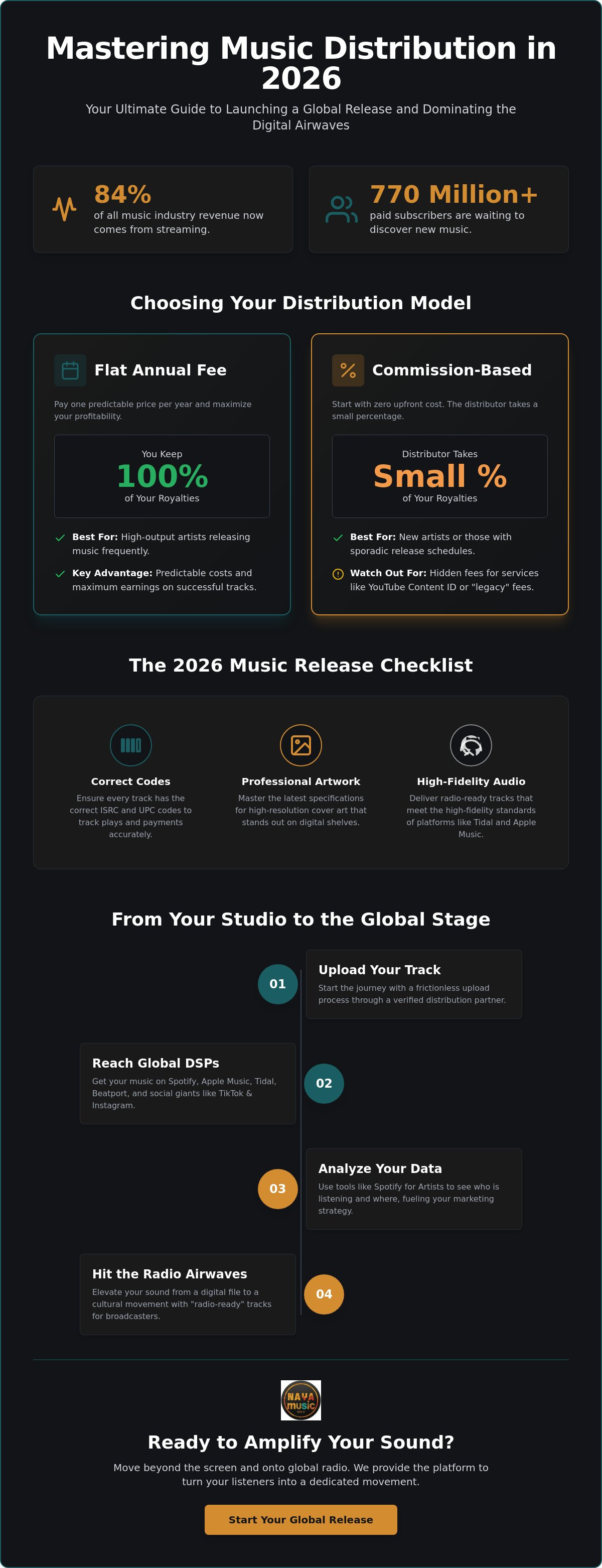
Streaming now accounts for 84% of all music industry revenue in 2026, which means your digital presence is no longer just a hobby; it is your global storefront. With over 770 million paid subscribers waiting to discover their next favourite track, the process of choosing a music distribution service often feels like a minefield of hidden fees and technical jargon. It's completely normal to feel overwhelmed by ISRC codes, UPC requirements, and the complex web of royalty collection. You want your music on Spotify and Apple Music, but you also want to know that every penny you earn finds its way back to your pocket.
We understand that you're looking for a partner, not just a platform. This guide will help you master the technical hurdles and strategic moves needed to launch a successful global release on all major DSPs. You'll learn how to decode the royalty ecosystem and build a professional artist brand that moves beyond the screen and onto global radio airwaves. We're breaking down the process from your first upload to a full-scale promotional plan that turns listeners into a dedicated movement.
Key Takeaways
- Discover why a verified distribution partner is your essential gateway to reaching listeners on major global platforms like Apple Music and Spotify.
- Gain total clarity when choosing a music distribution service by weighing the benefits of flat-fee subscriptions against flexible commission-based models.
- Secure your spot on the digital shelves by mastering the latest 2026 technical specifications for high-resolution audio and professional artwork.
- Navigate the upload process with a frictionless, step-by-step guide designed to get your music live and earning royalties across the globe.
- Elevate your sound from a digital file to a cultural movement by preparing "radio-ready" tracks that demand attention from international broadcasters.
What is Music Distribution and Why Do Independent Artists Need It?
Digital Music Distribution is the high-octane engine that drives your music from the studio directly to the ears of millions. Think of it as the vital infrastructure connecting your creative output to the global marketplace. In the past, you needed a massive record label budget to get your physical records onto shop shelves. Today, Digital Music Distribution has democratised the industry, allowing independent UK artists to bypass traditional gatekeepers. When you're choosing a music distribution service, you aren't just picking a tool to upload files; you're selecting a partner to manage your intellectual property and ensure your hard work generates revenue.
You might wonder why you can't simply upload your latest track directly to Spotify or Apple Music. These platforms, known as Digital Service Providers (DSPs), are built to handle massive catalogues from verified sources. They don't have the capacity to verify the identity, rights, and metadata of millions of individual creators. Distributors act as the quality control and administrative layer. They ensure every track has the correct ISRC and UPC codes to track plays and payments accurately. This is the first essential step in building a global movement for your artist brand.
The Role of Digital Service Providers (DSPs)
DSPs are the digital homes where your fans live. While Spotify and Apple Music dominate the UK market, a true global movement requires presence on platforms like Tidal for audiophiles and Beatport for electronic music specialists. A professional distributor ensures your metadata is flawless and your audio meets high-fidelity standards. This visibility extends far beyond London or Manchester. It reaches massive emerging markets such as NetEase in China and Boomplay across Africa. DSPs rely on these verified partners to deliver the high-quality sound and accurate data their subscribers expect.
Why You Need a Distribution Partner in 2026
The music industry in 2026 is data-driven and fast-paced. A distribution partner provides the automated royalty tracking systems you need to get paid fairly. They handle the complex task of collecting mechanical and performance royalties from every corner of the globe. You also gain access to powerful data dashboards. Tools like Spotify for Artists and Apple Music for Artists allow you to see exactly who is listening and where they are located. This information is gold for planning UK tours or social media campaigns. Choosing a music distribution service that offers transparent, real-time reporting is the first step in moving from a local act to an international powerhouse.
Choosing a Music Distribution Service: Flat Fee vs. Commission
Your financial strategy is just as vital as your sound. When you're choosing a music distribution service, the first fork in the road is the payment model. High-output artists who drop a new single every month typically find the greatest value in a Flat Annual Fee model. You pay one upfront price per year and keep 100% of your earnings. It's a predictable, business-like approach that rewards your productivity. If you plan to release music frequently, this is your path to maximum profitability.
Newer creators or those with a more sporadic release schedule often prefer the Commission-based model. It removes the barrier of entry by offering zero upfront costs. Instead, the distributor takes a small percentage of your royalties. This is a frictionless way to start your movement without financial risk. However, you must look beyond the initial price tag. Always verify the "Store Reach" of your potential partner. In 2026, your music must be available on TikTok, Instagram, and YouTube Shorts to stand a chance at going viral. If a service doesn't cover these social giants, your growth will stall before it even begins.
Watch out for the fine print. Some services lure you in with low headline rates but charge extra for YouTube Content ID or annual "legacy" fees to keep your music online if you ever cancel your subscription. These hidden costs can quickly erode your budget. If you're looking for a platform that champions your growth while providing a global stage, explore the artist support at NAYA Music Radio to amplify your reach.
Key Features to Evaluate Before Signing
Speed is your greatest asset. Some distributors can get your track into stores within 24 hours, while others lag behind with two-week processing times. Look for a partner that offers robust marketing tools. Integrated pre-save links and smart-URL generators are essential for building momentum before your release date. Don't overlook customer support. When a technical glitch hits during your release week, you need a responsive team that understands the urgency of your launch. A delay of even a few days can ruin a carefully planned marketing campaign.
Royalty Splits and Collaboration
Royalty splits are the digital agreements that ensure every contributor gets their fair share of the earnings automatically. If you're collaborating in a London studio, you can set these percentages so the distributor pays your producer and featured artists directly. This transparency prevents disputes and keeps your creative relationships healthy. Above all, ensure you maintain 100% ownership of your master recordings. Your music is your legacy; choosing a music distribution service that respects your rights is non-negotiable for long-term success.
The 2026 Music Release Checklist: Technical and Creative Specs
Your music is finally ready for the world. Now you must ensure it's "store-ready" to meet the rigorous demands of global platforms. In 2026, listeners expect studio-grade quality as the standard, not a luxury. When you're choosing a music distribution service, you need a partner that supports high-resolution audio formats without compromise. High-fidelity sound is the baseline for modern streaming. Deliver your tracks as 24-bit/44.1kHz WAV files to ensure your production remains crisp on Apple Music and Spotify's lossless tiers. Don't upload MP3s. They lack the sonic depth required for professional environments and will make your brand feel amateur.
Visuals are your first impression on a crowded digital shelf. Your cover art must be a perfect 3000x3000px square in RGB mode to avoid distortion. Stores are stricter than ever about what appears on your artwork. Prohibited items include website URLs, social media handles, or pixelated logos. If your art looks cluttered or low-quality, the algorithms might overlook your release entirely. Keep your design clean and impactful. Professionalism starts with the pixels, and a sharp image signals to both fans and curators that you're a serious artist.
Metadata and ISRC Codes Explained
Every track needs a digital fingerprint to track its journey. This is your ISRC code. It follows your audio across every platform, ensuring that every stream is logged and every penny of royalty reaches your bank account. If you're releasing an album or EP, you'll also receive a UPC code to track the project as a whole. Accuracy is your best friend here. Double-check the spelling of every songwriter, producer, and contributor. Correct metadata helps DSP algorithms place your music in front of the right audience by accurately categorising your genre and mood.
Visual Branding for Small Screens
Most fans will discover your sound on a smartphone. Your artwork needs to pop on a tiny interface. Avoid tiny text or over-complicated designs that become unreadable when shrunk down to a thumbnail. Align your visual style with your sonic identity to build a cohesive movement around your music. Stores will reject your release if it contains "outdated" logos or blurry imagery. When choosing a music distribution service, look for one with a clear preview tool so you can see how your art looks on mobile before you go live.
Legal Clearances: The Final Hurdle
Before you hit the upload button, verify your rights. Every sample must be cleared. Every licensed beat needs a valid contract. If you use uncleared material, your distributor will be forced to take your music down. This can lead to permanent bans from major stores and destroy your reputation. Protect your career by securing every legal clearance well before your launch date. A clean legal slate is the only way to build a sustainable global brand.
Step-by-Step: How to Upload and Launch Your Track Globally
Launching your music is a moment of pure adrenaline. You've polished the sound and perfected the art; now, it's time to execute. When choosing a music distribution service, you want an interface that feels like a cockpit, not a maze. Follow this methodical path to ensure your track lands with maximum impact across every digital storefront and streaming platform.
- Step 1: Create your account and select your release type. Whether it's a standalone Single, a punchy EP, or a full-length Album, this choice defines your project's structure in the digital ecosystem.
- Step 2: Upload your high-res audio and final artwork. Use the 24-bit WAV files and 3000px artwork we discussed in the technical specs section to ensure your quality remains uncompromised.
- Step 3: Input detailed metadata. This includes your lyrics, songwriter credits, and specific radio-edit designations. Accurate metadata makes your music searchable and ensures you get credited for every play.
- Step 4: Set a strategic release date. Resist the urge to go live immediately. Choose a Friday at least 3 to 4 weeks in the future to give your promotional engine time to warm up.
- Step 5: Review and submit. Conduct a final check of your spelling and audio files before sending your work for global distribution.
Execution is everything. If you're ready to see your music reach its full potential, submit your latest track to NAYA Music Radio and join a movement of emerging global talent.
Why the 4-Week Lead Time is Non-Negotiable
Success in 2026 requires more than just being "online." You need to trigger the algorithms. A 4-week lead time allows you to access the Spotify for Artists dashboard to pitch your track directly to editorial playlisters. This window is essential for landing on "Release Radar" and "New Music Friday" playlists, which can skyrocket your stream counts overnight. This buffer also gives professional broadcasters enough time to process your free song submission radio request, ensuring your music is queued for airplay the moment it drops.
Geographic Launch Strategy
Your movement might start in London, but its destination is global. Use your distributor’s dashboard to select specific territories for your launch. You can target regional hubs like New York or Atlanta by setting custom pricing for international markets. This allows you to stay competitive in different economies while maximising your reach. Coordinate your social media announcements to hit during peak hours in your target time zones. A synchronized launch creates a sense of immediacy and scale, proving that your brand is ready for the international stage. Choosing a music distribution service with robust territorial controls is the key to turning a local release into a worldwide event.
Maximizing Reach: From Digital Stores to Radio Airwaves
Choosing a music distribution service is the vital first step, but it's only the foundation of your global movement. Once your track is live on Spotify and Apple Music, the real work of building a fanbase begins. Many artists make the mistake of thinking the "submit" button is the finish line. In reality, it's the starting block. To truly stand out in 2026, you must move beyond the digital shelf and into the daily lives of your listeners through active promotion and social media amplification. Distribution gets you into the store; promotion gets you into the heart of the culture.
One of the biggest hurdles for independent creators is the gap between a raw demo and a radio-ready master. A radio-ready track has the sonic depth, clarity, and professional polish required to sit alongside major label releases. This professional sheen is what catches the ear of station directors and global playlisters. NAYA Music Radio serves as the ultimate bridge here, taking your digital upload and placing it before global ears. Through artist interviews and social spotlighting, we turn your music from a simple audio file into a shared cultural experience that resonates across borders.
Getting Your Music on the Radio
Radio airplay provides a level of legitimacy that streaming numbers alone cannot match. When your track hits the airwaves in cultural hubs like London or Washington DC, it signals to the industry that you've arrived. Transitioning from a casual stream to a dedicated rotation slot requires a professional, calculated approach. You can master this by leveraging how to release music independently UK strategies to ensure every aspect of your launch is flawless. This roadmap helps you navigate the complexities of promotion, ensuring your sound reaches the international stage with maximum momentum.
The Long-Term Play: Management and Studios
As your movement grows, you'll eventually need to transition from a DIY setup to professional artist management. This evolution allows you to focus on your craft while experts handle the business of visibility and growth. High-quality production remains the heartbeat of this journey. Investing in professional recording is non-negotiable for anyone serious about career longevity. Consider exploring a recording studio rental UK to ensure your next project meets the 2026 industry standards we discussed in the technical checklist. Your sound is your signature; make it undeniable.
Ready to amplify your story and take the next step in your career? Explore NAYA Music Radio Artist Promotion Packages to start your journey toward global visibility today.
Take the Global Stage
Your music deserves to be more than a silent file on a hard drive. By mastering the 2026 technical standards and respecting the critical four week lead time, you've already set yourself apart from the amateur crowd. You now understand that choosing a music distribution service is just the beginning of your professional evolution. It's the vital bridge that carries your sound from the local studio to a global audience of millions. Now, it's time to turn those digital streams into a cultural movement that spans continents.
We're here to help you scale that mountain with total transparency. Whether you need 24/7 global live radio streaming to build industry legitimacy or access to physical studio hubs in London, NY, and Atlanta to refine your next project, we provide the infrastructure for your growth. Our professional artist management and promotion packages are designed to remove every friction point between your creativity and the international stage. Start your global journey with NAYA Music Radio Artist Services and claim your spot in the spotlight. Your sound is ready; the world is listening.
Frequently Asked Questions
How much does it cost to distribute music to streaming platforms in 2026?
Costs vary depending on the model you select for your career. Flat-fee services like Ditto Music start at £19 per year for unlimited releases, while other providers like CD Baby charge approximately £10 per single. Factor in potential commissions or add-on fees for things like YouTube Content ID when you're calculating your total investment for the year.
How long does it take for my music to appear on Spotify and Apple Music?
Expect your music to go live within 48 hours to 5 days, though this varies significantly by store. We always recommend a 4-week lead time to maximise your promotional impact and trigger the right algorithms. This window gives you the necessary time to pitch for editorial playlists and ensure your metadata is flawless across all platforms.
Do I need a barcode or ISRC code to distribute my music?
You absolutely need these identifiers to track your success in the digital space. An ISRC code identifies the specific recording, while a UPC acts as the barcode for the entire single or album release. Most distributors generate these for you during the upload process, ensuring your streams are tracked and your royalties are paid accurately.
Can I distribute cover songs to streaming platforms?
You can distribute covers, but you must obtain a mechanical license to stay legal. This license ensures the original songwriters receive their fair share of the royalties from your version. Many modern distributors provide an integrated service to handle this paperwork for a small fee, keeping your release process frictionless and compliant.
What is the best music distributor for independent artists in London or New York?
Success in creative hubs like London or New York depends on your specific release volume. Choosing a music distribution service that offers 100% royalty retention is ideal for high-output artists, while commission-based models suit those just starting out with no upfront budget. Focus on services that provide robust data analytics and global store reach to build your movement.
How do I get paid from music streaming royalties?
Royalties are collected by your distributor from each platform and made available in your user dashboard. You can withdraw your earnings through standard UK payment methods like PayPal or a direct bank transfer. Keep in mind that streaming revenue usually takes 60 to 90 days to appear in your account after the streams actually occur.
Can I switch music distributors after my song is already live?
You can move your catalogue to a new provider without losing your valuable play counts. The key is to use the exact same ISRC codes and metadata during the transition to the new platform. Upload to your new distributor first, then issue a takedown request to your old one once the new version is verified and live.
How do I get my music played on the radio after it is distributed?
Distribution is only the first step; radio requires a direct and professional pitch. Submit your radio-ready tracks to NAYA Music Radio for a chance to reach a global audience via 24/7 live streaming. Radio play provides the industry validation and social amplification needed to turn a digital release into a real-world movement.


