
Landing a spot on a major Afrobeat playlist in 2026 isn't a game of luck; it's a calculated move in a high-stakes chess match where momentum is your strongest piece. You've likely spent hours perfecting an infectious rhythm and polishing your vocals to a shine, only to watch your submission disappear into a digital void. It's exhausting to see low stream counts when you know your sound belongs on the global stage. Understanding how to get featured on afrobeat playlists requires a shift from passive hoping to active, multi-channel strategy that builds real authority.
We're here to help you master the art of landing high-traffic Afrobeat playlist placements by combining professional production with strategic pitching and radio-driven validation. You'll learn how to build a repeatable release strategy that transforms your tracks from quiet uploads into loud cultural movements. This playbook explores the vital differences between editorial and user-generated lists, the power of professional studio environments in London, and how 24/7 radio rotation creates the buzz curators can't ignore. It's time to stop guessing and start growing your monthly listeners with purpose.
Key Takeaways
- Learn the three-tier hierarchy of modern playlists to navigate the 2026 Afrobeat landscape with precision and confidence.
- Discover how to get featured on afrobeat playlists by prioritizing high-fidelity production and flawless metadata that meets international broadcast standards.
- Implement a strategic 6-week release countdown to ensure your music reaches editorial curators long before it hits the digital shelves.
- Use 24/7 global radio rotation and social media amplification to generate the data-driven momentum that forces algorithmic playlists to take notice.
- Transition from an independent creator to a global protagonist by building a frictionless artist story through interviews and spotlight features.
The 2026 Afrobeat Playlist Landscape: Understanding the Gatekeepers
The global rhythm has shifted. In 2026, Afrobeat isn't just a trend; it's the dominant sound of the digital era. Streaming data confirms it's the fastest-growing genre worldwide, fueled by a massive diaspora and a global appetite for high-energy percussion. To succeed, you must understand the three tiers of gatekeepers standing between your track and the charts. This knowledge is the foundation of your movement. Success isn't a lottery; it's a strategic entry into a vibrant ecosystem.
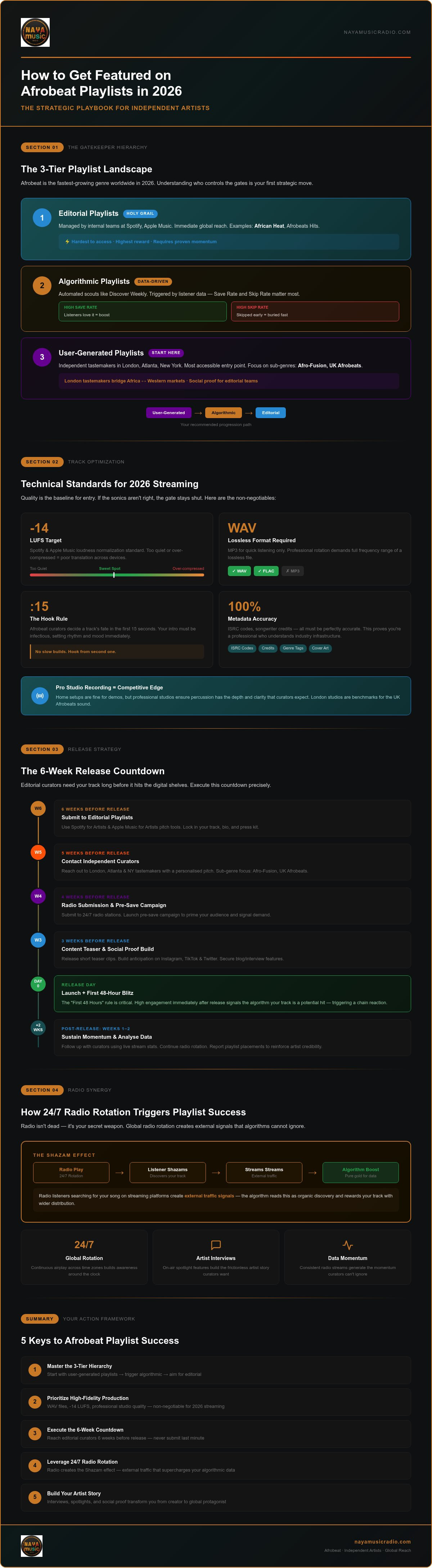
Editorial playlists are managed by internal teams at giants like Spotify and Apple Music. These are the "holy grail" placements that offer immediate global reach. Algorithmic playlists like Discover Weekly act as automated scouts, picking up tracks that show early signs of life through listener data. Finally, user-generated playlists are curated by independent tastemakers in cultural hubs like London, Atlanta, and New York. These London-based tastemakers are especially influential, acting as a bridge between the African continent and the Western market. They provide the essential social proof needed to trigger the larger machines.
Editorial vs. Independent Curators
While landing a spot on "African Heat" is the ultimate goal, your journey often begins with independent tastemakers. Independent curators offer a more accessible entry point for emerging talent. These curators often focus heavily on specific sub-genres like Afro-Fusion or UK Afrobeats. By targeting these niche communities first, you build the organic momentum required for editorial teams to notice you. Learning how to get featured on afrobeat playlists starts with proving your track can hold an audience's attention in these smaller, highly engaged circles. It's about building a home for your sound before moving to the global stage.
The Algorithmic Trigger: How to Feed the Machine
The robots are watching your every move. Algorithms don't care about your total stream count as much as they care about your "Save Rate" and "Skip Rate." If listeners are skipping your track in the first thirty seconds, the algorithm will bury it quickly. To avoid this, you need external signals to prove your music is worth hearing. Using free song submission radio creates a "Shazam effect" where listeners find your music on air and search for it on streaming platforms. This external traffic is pure gold for your data profile. The "First 48 Hours" rule is critical; high engagement immediately after release tells the system your track is a potential hit. This triggers a chain reaction that leads to those coveted algorithmic placements and sustained growth.
Optimizing Your Track for Professional Playlist Consideration
Your music is competing with global giants every single day. If the sonics aren't right, the gate stays shut. Mastering how to get featured on afrobeat playlists requires a relentless focus on technical excellence before you ever hit the submit button. Quality isn't just a preference; it's the baseline for entry into the 2026 streaming ecosystem. Curators expect a sound that is polished, punchy, and ready for a London club system or a high-end pair of headphones.
Technical Standards for 2026 Streaming
Achieving the "International Sound" starts with where you record. While home setups are great for demos, recording in a professional recording studio London ensures your percussion has the depth and clarity that home equipment often lacks. Major platforms like Spotify and Apple Music generally target -14 LUFS for loudness normalization. If your track is too quiet or overly compressed, it won't translate well across different devices. Always provide high-fidelity WAV files for your submissions. MP3s might be fine for a quick listen, but professional rotation demands the full frequency range of a lossless file.
You have exactly fifteen seconds to make an impression. Afrobeat curators often decide a track's fate in the first quarter-minute. This "15-Second Hook" rule means your intro must be infectious, setting the rhythm and mood immediately. Metadata mastery is equally vital. Ensure your ISRC codes and songwriter credits are 100% accurate. This attention to detail proves you're a professional who understands the industry's infrastructure. Don't forget your visual branding; high-quality cover art is the first thing a curator sees, and it should reflect the energy of your music perfectly.
Crafting a Compelling Artist Pitch
When you pitch, lead with your story. Curators want to connect with a person, not just a file. Write a bio that highlights your cultural roots and your unique vision for the genre. It's helpful to identify your "Sonic Cousins" to give curators a quick reference point. Comparing your sound to established stars like Burna Boy or Tems helps them understand where you fit in their existing programming. If you've already generated "Hometown Heat" in cities like Birmingham or Manchester, include those specific details. This local validation acts as a powerful signal of your growth potential. To truly stand out, you might want to explore an artist spotlight to build the professional authority that curators find irresistible.
The Step-by-Step Afrobeat Playlist Submission Strategy
Success in the Afrobeat world requires more than just talent; it demands a disciplined timeline. You can't expect a curator to move on your schedule if you're submitting tracks the night before they drop. A winning campaign starts at least four to six weeks before your release date. This window gives you enough time to build anticipation, secure blog features, and navigate the technical requirements of major streaming platforms. Mastering how to get featured on afrobeat playlists means respecting the lead times of the people who hold the keys to the kingdom.
Phase 1: Pre-Release Buzz and Editorial Pitching
Your first stop is the Spotify for Artists dashboard. This is where you draft your 500-character pitch. Don't waste space on generic praise. Focus on the track's vibe, your recent milestones, and why it fits a specific editorial mood like "Afro-Fusion" or "Global Grooves." Simultaneously, launch a pre-save campaign. High pre-save numbers tell the algorithm that your audience is ready to engage on day one. Secure a few early blog features to provide the "social proof" curators look for when they see your name in their submission queue.
Phase 2: Direct Outreach to Independent Tastemakers
Independent curators are the lifeblood of the underground scene. Use Instagram and LinkedIn to find the people behind the playlists that are currently moving the needle in London and beyond. When you reach out, skip the "To Whom It May Concern" template. Use their name. Mention a specific track they've recently supported. This level of personalization shows you've done your homework and respect their taste. You can find more granular advice in our guide on music promotion tips to help you build a high-quality database of relevant contacts.
Be wary of third-party platforms that promise thousands of streams for a small fee. In 2026, bots are easily detected and can lead to your music being removed from platforms entirely. Stick to legitimate submission tools and maintain professional follow-up etiquette. If you haven't heard back after ten days, send a polite, short message. Keep it focused on the music's performance or a new milestone you've reached since the last email. This persistence, paired with a solid strategy, ensures you stay on the radar without becoming a nuisance. Your goal is to build a relationship, not just secure a single transaction.
Building the Narrative: Social Proof and Radio Synergy
A great song is just the beginning. In 2026, curators are looking for an established vibe before they click "Add." They want to see that your music is already living in the wild. High engagement on Instagram and TikTok acts as a green light for editorial teams. If you want to know how to get featured on afrobeat playlists, you must prove that your audience is already dancing to your rhythm. Regional dominance in cultural hubs like London or Atlanta shows curators that your track has the legs to go global. When you show up with a pre-built community, you aren't just asking for a favour; you're offering a proven hit.
The Power of the Radio Interview
Nothing builds authority faster than a professional conversation. A music interview promotion gives you a library of high-quality content to feed your social channels. These clips serve as undeniable proof that major broadcasters are already paying attention. When a curator sees you confidently discussing your craft, you stop being a random submission and start being a professional artist. You can turn a radio spotlight into a powerful "Featured Artist" headline for your EPK, making your next pitch significantly more persuasive. It's about building a person behind the music that listeners can actually connect with.
Social Media Amplification for Afrobeat Success
Visibility is a choice you make. Use targeted ads to reach fans of established Afrobeat stars in key geographic hubs. In London, the scene is particularly vibrant, so focus your energy there to build a solid foundation. The "Stitch" strategy on TikTok is another essential tool; engage with top Afrobeat dancers to get your sound into their choreography. This creates a ripple effect that the algorithms can't ignore. Creating playlist-friendly content, like studio snippets or viral dance challenges, makes it easy for curators to see how your track fits into their world. Social proof acts as a critical risk reducer for curators by demonstrating that your track is a safe bet for their listeners.
To truly bridge the gap between local heat and international rotation, you need a partner who understands the rhythm of the industry. You can book an artist spotlight today to start building the professional narrative that secures major placements and expands your global reach.
Scaling Your Reach: How NAYA Music Radio Triggers Playlist Success
The final piece of the puzzle isn't found on a digital dashboard; it's found on the global airwaves. Radio airplay remains the most potent catalyst for digital discovery in 2026. When your track hits NAYA's 24/7 global broadcast, it triggers the "Shazam effect." Listeners hear your rhythm, identify the song, and immediately search for it on streaming platforms. This surge in external traffic is exactly what editorial teams track when deciding how to get featured on afrobeat playlists. It transforms your music from a static file into a living, breathing movement that curators simply cannot ignore.
From Airwaves to Algorithms
Radio spins do more than just reach ears; they build your "Popularity Score." This internal metric on streaming platforms is heavily influenced by how many people are searching for your music outside of the app. By starting with free song submission radio, you create a data-driven foundation that feeds the algorithms. Our music distribution for emerging artists ensures your metadata is flawlessly formatted for over 150 global platforms. This ensures that when the algorithm is ready to pick you up, your track is technically ready for the spotlight. Scaling your sound requires this multi-channel approach, and understanding how to get featured on afrobeat playlists is only half the battle; you also need the radio-driven momentum to stay there.
Your Global Stage-Builder Partner
NAYA acts as the ultimate home for independent Afrobeat creators. We've removed the barriers that traditionally kept talent in the shadows. Whether you're utilizing our physical studios in London or seeking professional guidance through artist management UK, we provide the infrastructure you need to scale. Our frictionless ecosystem is designed to take you from a raw recording to global rotation without the hidden complexities of the old industry model. You are the protagonist of this story, and we are the stage-builders here to amplify your voice and celebrate your cultural contribution.
The path to the top is clear. It requires professional sound, a compelling narrative, and the right partners to trigger the machine. Submit your track to NAYA Music Radio today and start your journey to the top of the playlists!
Own the Global Afrobeat Movement
The path to the global stage is no longer blocked by distant gatekeepers; it's paved with strategic action and professional intent. You've learned that mastering how to get featured on afrobeat playlists requires a blend of high-fidelity production, a compelling artist story, and the relentless momentum that only 24/7 radio rotation can provide. Success in 2026 belongs to the creators who treat their music as a cultural movement, ensuring every track is polished in professional London studios and distributed to over 150 global platforms with absolute precision.
By aligning your talent with a partner that offers global radio reach and social amplification, you remove the friction from your journey. You don't have to navigate this complex landscape alone. Whether you're recording your next hit in our physical studios or leveraging our expert management services, the destination is clear. It's time to stop waiting for permission and start building your legacy on the world stage.
Start your global Afrobeat journey with NAYA’s Free Song Submission!
Your sound is ready for the world. We're here to make sure the world is ready for you.
Frequently Asked Questions
How much does it cost to get on a major Afrobeat playlist?
Placement on major editorial playlists is free and based entirely on merit and data. You should never pay a curator directly for a guaranteed spot, as this often violates platform terms and can lead to your music being removed. Instead, invest your budget into professional production or legitimate promotion services that build the organic momentum curators look for when deciding how to get featured on afrobeat playlists.
Can I get on Spotify editorial playlists as an unsigned artist?
You absolutely can land editorial placements without a label by using the Spotify for Artists pitch tool. Unsigned artists are a massive part of the Afrobeat movement, and curators are constantly hunting for fresh, independent talent. Focus on submitting your track at least four weeks before release to ensure the editorial team has time to review your music and consider it for their top-tier lists.
What is the best time of week to release a new Afrobeat track for playlisting?
Friday remains the industry standard for new releases because it aligns with the Global Release Day and the refresh cycle of major playlists. Releasing on a Friday ensures you have a full week of data to contribute to the next week's chart calculations. This timing is essential for maximizing your visibility and giving the algorithms enough time to track your initial engagement and save rates effectively.
How many monthly listeners do I need to get noticed by curators?
There is no magic number of monthly listeners required to catch a curator's eye. Industry professionals often prioritize your save-to-stream ratio and social media engagement over raw listener counts. A track with 5,000 highly engaged fans who save and share the music is often more attractive to a curator than a track with 50,000 passive listeners who skip after thirty seconds without any interaction.
Is it better to target global Afrobeat playlists or regional ones like 'London Afrobeats'?
Start by targeting regional and niche playlists like 'London Afrobeats' to build a solid foundation of social proof. These smaller, community-focused lists act as a bridge to global editorial consideration. When you dominate a specific city or sub-genre, you prove to major curators that your sound has a dedicated home, making it much easier for them to justify adding you to larger, international collections later.
What happens if my song is added to a playlist but then removed quickly?
If your song is removed quickly, it usually means the skip rate was too high for that specific audience. Don't be discouraged; it's a signal to analyze your track's intro or your targeting strategy. Use this data to refine your next release, ensuring your hook is more immediate or that you are pitching to curators whose taste more closely aligns with your specific sonic style and cultural vibe.
Does getting radio airplay actually help with Spotify playlisting?
Radio airplay is a massive driver for playlist success because it creates external signals that streaming algorithms love. When listeners hear your track on air and search for it on Spotify, your popularity score increases. This tells curators that your music is in demand in the real world, significantly improving your chances of how to get featured on afrobeat playlists through editorial or algorithmic selection.
How do I find the contact information for Afrobeat playlist curators?
You can find curator contact details by searching for playlist names on Instagram, TikTok, or LinkedIn. Many independent curators list their submission preferences or email addresses in their bios. Alternatively, use professional submission platforms that act as a bridge between artists and tastemakers. Always keep your outreach personal and professional to build the long-term relationships that sustain a successful music career in the global Afrobeat scene.


