
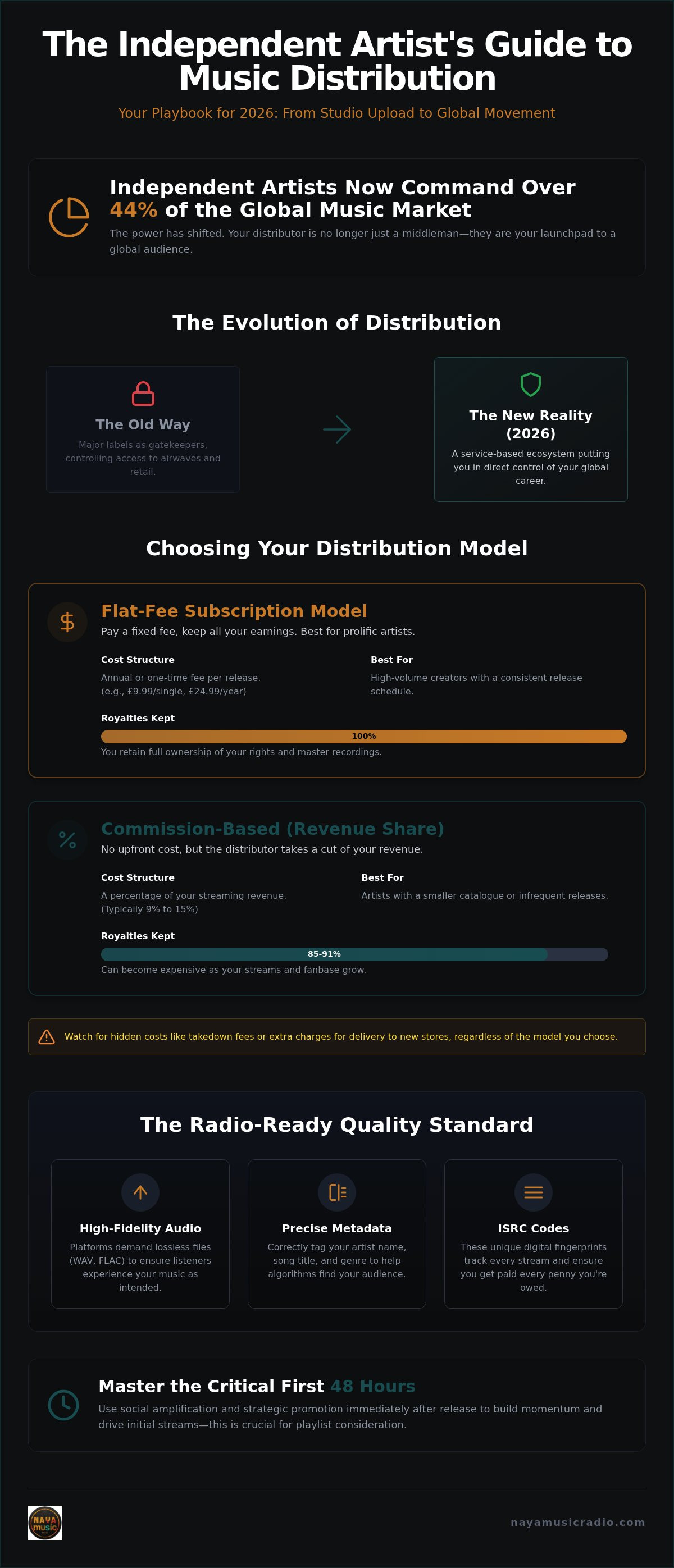
Independent artists now command over 44% of the music market share, yet most releases still struggle to break through the digital noise. In 2026, simply getting your tracks on Spotify is the bare minimum, not the final goal. You've likely dealt with the headache of hidden fees or the confusion of royalty collection while your music sits on a digital shelf with zero streams. It is time to stop treating your art like a transaction and start treating it like a cultural movement. This guide simplifies music distribution for independent artists, ensuring your sound reaches every corner of the globe without the usual industry friction.
We understand that you want more than just a presence on DSPs; you want a clear path to professional airplay and a brand that attracts serious management. We promise to show you how to turn a simple upload into a global movement with the transparency and energy you deserve. We will explore the transition from digital distribution to live radio, the removal of technical barriers like ISRC confusion, and the strategies needed to build a sustainable micro-economy around your fanbase. Your journey from the local studio to the global stage starts here.
Key Takeaways
- Understand the evolution of music distribution for independent artists from a gatekeeper model to a service-based ecosystem that puts you in control of your career.
- Compare flat-fee and commission-based models to ensure you retain maximum royalties while avoiding the hidden costs often found in digital contracts.
- Learn the specific technical standards needed to ensure your tracks are radio-ready for professional airplay in global hubs like London.
- Master the critical first 48 hours of your release by using social amplification and strategic promotion to build immediate momentum and drive streams.
- Discover how to create a frictionless transition from recording in professional studios to reaching a global audience through integrated radio streaming and artist spotlights.
What is Music Distribution for Independent Artists in 2026?
In 2026, music distribution for independent artists has transformed from a rigid logistics chain into a high-octane launchpad for global movements. Historically, major labels acted as the ultimate gatekeepers. They decided who reached the airwaves and who stayed in the basement. Today, that power has shifted into your hands. Digital distribution acts as the technical bridge, carrying your creative vision from the recording booth directly to the ears of millions. It's the process of delivering your audio files, along with critical data, to every major digital storefront simultaneously.
Standing out in a saturated market requires more than a simple upload. Your distributor is no longer just a middleman; they're a vital service provider. To succeed, you must master the essential components of a professional release:
- High-Fidelity Audio: Platforms demand lossless files to ensure listeners experience every beat as intended.
- Precise Metadata: This includes your artist name, song title, and genre, which helps algorithms find your audience.
- ISRC Codes: These unique digital fingerprints track your streams and ensure you get paid every penny you're owed.
The Shift from Physical to Frictionless Digital
The days of pressing limited CDs and hoping for shelf space in a Soho record shop are long gone. We've moved into an era of frictionless digital participation where access is the new currency. Emerging creators in hubs like London and New York are now driving global trends through 24/7 streaming availability. This shift allows you to record a track in a professional studio and have it live across the globe within days. It removes the physical barriers to entry. Your sound can now resonate from the UK to the US without shipping costs, manufacturing delays, or inventory risks. It's about moving at the speed of culture.
Key Industry Players: DSPs vs. Distributors
Understanding the ecosystem is vital for your long-term career growth. On one side, you have music streaming services like Spotify, Apple Music, and Amazon Music. These are the destinations where fans consume your work. On the other side is your distributor, the logistical engine that ensures your music meets the strict requirements of these platforms. While DSPs host the music, your distribution partner manages the royalty collection and data analytics that fuel your growth. In 2026, the most successful artists use these digital tools alongside international radio play to validate their sound. This combination builds a professional brand that attracts management and secures your place on the global stage.
Choosing the Best Music Distribution Model for Your Career
Your choice of partner determines your career's financial health and creative freedom. In the modern landscape, music distribution for independent artists isn't just about moving files; it's about selecting a business model that fuels your growth rather than draining your budget. You must decide whether a flat-fee subscription or a commission-based structure fits your release schedule. High-volume creators often thrive with flat fees, such as £24.99 per year for unlimited uploads, while those with a smaller catalogue might prefer a one-time fee of £9.99 per single. Regardless of the cost, your distributor must allow you to keep 100% of your rights and master recordings. Ownership is the bedrock of your movement.
Scalability is equally vital. Your distributor should be a bridge that carries your sound from local hubs like London or Atlanta to the global stage without friction. As your streams climb into the millions, you don't want a partner that takes a larger slice of your success. When evaluating your options, consult authoritative resources like Spotify's preferred and recommended distributors to ensure your provider meets high technical and ethical standards. This transparency ensures you aren't hit with unexpected hurdles when your career begins to accelerate.
Commission-Free Distribution vs. Revenue Sharing
Analyzing the long-term cost of your distribution is essential. Commission-free models usually require an annual subscription but let you keep every penny of your streaming revenue. In contrast, revenue-sharing models take a commission, often around 9% to 15%, which can become expensive as your fanbase grows. Watch out for hidden costs like takedown fees or extra charges for delivery to new digital storefronts. Fair-trade distribution in 2026 is an ethical partnership where artists retain full ownership of their masters while receiving transparent, value-led support without predatory commissions.
Beyond the Digital Shelf: Distribution Plus Promotion
Distribution alone is no longer enough to build a sustainable career. The digital shelf is crowded, and simply being "available" won't drive engagement. You need a strategy that builds a narrative around your music. Professional music interview promotion is a powerful tool for this, as it transforms a track into a story that fans can connect with. NAYA integrates these promotional elements directly with distribution, placing your music into active radio rotation. This approach ensures your release isn't just a drop in the ocean but a coordinated strike. If you're looking for a partner that values your visibility as much as your files, explore how NAYA Music Radio can amplify your reach through integrated radio and distribution services.
Preparing Your Track: The Radio-Ready Quality Standard
The "upload" button is the easiest part of the journey. The real challenge in music distribution for independent artists is ensuring your track doesn't get rejected by distributors or ignored by high-tier radio programmers. Professional mixing and mastering are non-negotiable in 2026. If your track sounds thin or muddy compared to a chart-topping hit, listeners will skip it within seconds. Radio stations in London or DC operate with strict broadcast standards. They require tracks that are loud, clear, and dynamically balanced. Without that "commercial" polish, your song won't make it past the initial screening process of any major station.
Visual identity is your second handshake with the industry. Your cover art must be high-resolution and professionally designed to stand out on a crowded digital shelf. It's the first thing a fan, playlist curator, or manager sees. If the artwork looks amateur, they'll assume the music is too. A cohesive brand across your visuals and sound creates the professional image needed to move from a bedroom creator to a global movement. Don't let a low-quality JPEG or a poorly leveled vocal be the reason your career stalls at the starting line.
The Value of Professional Studio Spaces
Home recording setups have improved, but they rarely pass the "radio test" for major FM or digital stations. Home rooms often lack the acoustic treatment needed to prevent muddy low-ends or harsh reflections. Finding a professional recording studio in London or Atlanta gives you access to treated environments and high-end preamps. This equipment captures the sensory nuances of your performance that a budget interface simply misses. It's the difference between a flat, demo-quality recording and a vibrant, professional sound that demands attention on the airwaves.
Checklist for a Successful Distribution Submission
Technical errors are the primary cause of release delays. Metadata is the spine of your distribution; one typo in a featured artist's name can ruin your release day momentum and split your streaming data. Audio resolution matters just as much. Most distributors require 16-bit or 24-bit WAV files at 44.1kHz. Never upload MP3s for professional distribution. Use a radio-ready music checklist to verify your technical specs before you hit send. This ensures a frictionless submission process and gets your music into the ears of your global audience faster.
How to Promote Your Distributed Music Globally
Your distribution deal is signed and your tracks are live, but the real work begins now. In 2026, the first 48 hours of a release determine its trajectory on every major streaming algorithm. You must maximize this window to trigger the data-driven momentum that shifts a track from a quiet upload to a global movement. Effective music distribution for independent artists relies on a coordinated strike across digital platforms and traditional media. Don't just post a link; create an event. Humanize your brand through radio interviews that tell your story. This connection turns casual listeners into a loyal fanbase in hubs like Washington DC, New York, and London.
Building this foundation requires a mix of digital savvy and professional validation. While streaming platforms offer reach, they often lack the "active" engagement found in broadcasting. Radio rotation provides the authority needed to separate professional talent from the hobbyists. It's about being heard, not just being available. By focusing on active promotion, you ensure your music doesn't just sit on a digital shelf but actually reaches the ears of those who can move your career forward.
Social Media and Viral Momentum
Short-form video is your most powerful tool for teasing distributed tracks before they launch. Use 15-second clips to build anticipation and encourage fan-created content. Social amplification isn't just about likes; it's about turning a local hit into a global movement by engaging fans across different time zones. When your sound resonates in a specific cultural hub, the momentum naturally spills over into international markets. This frictionless growth is possible when you treat your social presence as a 24/7 stage for your art. It creates a sense of belonging for your audience, turning them into advocates for your movement.
Radio Rotation and Artist Spotlights
There's a massive difference between "passive" streaming, where your music might be background noise, and "active" radio listening. Radio listeners are tuned in for the curation and the personality. To capitalize on this, you should submit music to radio to secure maximum exposure during your release week. Artist spotlights further establish your authority in your genre, positioning you as a leader within your scene. This level of professional branding is what attracts management and high-level sync deals. Ready to take your sound to the next level? Start your journey with NAYA Music Radio and get the global visibility your music deserves.
The NAYA Approach: A Frictionless Path to the Global Stage
NAYA Music Radio isn't just another platform; it's a movement designed to dismantle the traditional barriers of the music industry. We believe that music distribution for independent artists should be a celebratory milestone, not a technical headache. By acting as a global stage-builder, we provide the infrastructure that turns local talent into international icons. Our ecosystem removes the friction of hidden fees and complex contracts, offering professional transparency that lets you focus on your craft. We've built a destination where your creativity is championed, ensuring your sound travels from the recording booth to our 24/7 live stream without losing its soul.
The power of our platform lies in its reach. While traditional distributors might leave your tracks to gather digital dust, our 24/7 live radio streaming ensures your music is constantly active. This active rotation reaches international audiences across multiple time zones, providing a level of visibility that static playlists simply can't match. We bridge the gap between local scenes and the global market, providing a supportive partner that guides you through every step of the professional journey. It's time to stop waiting for permission and start building your own stage.
A Hub for Creators in London, New York, and Beyond
We provide more than just digital uploads; we offer a physical home for your sound. With professional studio rentals in London, NYC, Atlanta, and DC, you can record your next hit using high-end equipment that guarantees a radio-ready sound. This integrated approach allows you to transition seamlessly from production to distribution. You also gain access to our combined artist management UK and US expertise. This cross-continental knowledge ensures your career strategy is robust enough to handle the complexities of the modern industry. NAYA is the ultimate destination for the visionary artist who demands authenticity and growth.
Get Started with NAYA Distribution Today
Taking the next step in your career is simple and direct. We offer end-to-end distribution and promotion packages that cover everything from the initial upload to social amplification. Our process is designed to be user-centric, placing you at the heart of the story. You can submit your song for radio rotation through our streamlined portal, ensuring your music gets the spotlight it deserves. We handle the logistical details, metadata, and international delivery so you can stay focused on the movement you're creating. Your global audience is waiting for your sound. Distribute your music with NAYA Music Radio today!
Build Your Global Movement Today
The digital landscape of 2026 demands much more than a simple presence on streaming platforms. It requires a strategic blend of high-fidelity production, transparent distribution models, and active promotion that humanizes your brand for a global audience. Mastering music distribution for independent artists is the definitive first step toward turning a single track into a sustainable career. We've explored how to maintain 100% ownership of your masters while leveraging professional radio rotation to break through the saturated market noise.
NAYA provides the frictionless infrastructure you need to succeed. We offer 24/7 global radio exposure alongside professional studio rentals in London, NYC, Atlanta, and DC. Our 100% artist-centric management ensures you remain the protagonist of your story as you transition from local scenes to international hubs. You don't have to navigate these complexities alone. Start your global music journey with NAYA Music Radio distribution and claim your place on the world stage. Your sound is ready and the stage is already built. It is time to let the world hear the movement you've created.
Frequently Asked Questions
How much does music distribution for independent artists cost in 2026?
Costs vary significantly based on your chosen business model. Flat-fee subscriptions typically range from £20 to £45 per year for unlimited uploads, which is ideal for prolific creators. Alternatively, single-release fees often sit around £10 per track for those with a smaller catalogue. Some providers offer commission-based models with zero upfront cost, but they take a percentage of your long-term earnings instead. Always check for hidden add-ons like YouTube Content ID fees.
Can I distribute my music to Spotify and Apple Music for free?
You can use commission-based distributors that offer zero upfront fees to access major platforms. However, these services typically take 10% to 15% of your earnings in exchange for the "free" service. Truly free tiers without any commissions have largely disappeared in 2026. It's often more cost-effective for successful artists to pay a flat annual fee and keep 100% of their streaming revenue rather than sharing their profits forever.
How long does it take for my music to appear on streaming platforms?
Most digital service providers require 10 to 14 days to process and vet your release properly. While some distributors claim 48-hour delivery, rushing the process often leads to missed playlist pitching windows. Aim to submit your tracks at least three to four weeks before your release date. This buffer ensures your metadata is verified and gives you the time needed to build marketing momentum across your social channels.
What is the difference between a music distributor and a record label?
A distributor provides the technical bridge to get your files onto DSPs, while a label traditionally handles funding, marketing, and creative direction. In 2026, music distribution for independent artists focuses on providing essential services like royalty collection and data analytics without taking your rights. Labels often demand a large percentage of your master ownership. Using an independent distributor allows you to retain full creative control and 100% of your earnings.
Do I keep 100% of my royalties when using independent distribution?
This depends entirely on your specific contract. Many flat-fee distributors allow you to keep 100% of your streaming royalties after the annual subscription is paid. Commission-based models, however, will take a slice of every stream you generate. Always read the fine print regarding social media revenue. Some providers take a 20% cut from platforms like TikTok and YouTube even on their paid plans, so transparency is vital for your financial health.
How do I get my distributed music played on the radio?
Distribution alone does not guarantee airplay; you must actively pitch your tracks to station programmers. Focus on creating radio-ready masters and high-quality electronic press kits that stand out. You can use integrated platforms that offer both distribution and radio rotation to streamline this process. Securing interviews and artist spotlights helps humanize your brand, making it much more likely that global stations will add your sound to their active rotation.
What are ISRC codes and why do I need them for distribution?
International Standard Recording Codes (ISRC) are unique digital fingerprints for every individual track you release. They are essential for tracking sales and streams across different platforms globally. Without these codes, you cannot accurately collect your royalties or monitor your performance data. Most distributors will generate these for you automatically during the upload process, ensuring your music is properly identified and protected within the digital ecosystem.
Can I change my music distributor after my music is already live?
You can switch distributors, but it requires careful coordination to keep your stream counts and playlist placements. You must upload the tracks to your new provider using the exact same ISRC codes and metadata before taking the old versions down. This process ensures a frictionless transition and prevents your music from disappearing from fan libraries. Most professional distributors provide specific migration guides to help you move your catalogue without losing momentum.


