
Did you know that even in 2026, terrestrial radio reaches a staggering 82% of Americans every single week? While digital uploads now exceed 150,000 tracks daily, airplay remains the premier credibility engine for independent creators looking to stand out. You've likely felt the sting of being ignored by major station gatekeepers or felt the isolation of being outside industry hubs like London and NYC. Learning how to get music on radio rotation is no longer about waiting for a lucky break. It's about mastering a professional, strategic system that treats your talent like the global movement it is.
We understand the confusion surrounding technical "radio-ready" standards and the frustration of "showola" practices that pressure artists for free labor. This playbook promises to help you master the exact steps to transition from local recording to global radio rotation with our expert-led strategy. We'll explore the latest FCC regulatory updates, provide a roadmap for navigating promotion costs, and show you how to secure the professional interviews that build a lasting fanbase. It's time to stop being a spectator and start building your own stage on the global airwaves.
Key Takeaways
- Distinguish between heavy and light rotation to strategically map out your path from a new discovery to a chart-topping hit.
- Meet non-negotiable broadcast standards by mastering technical LUFS levels and clean edits for a professional, radio-ready sound.
- Unlock the exact steps on how to get music on radio rotation by choosing the right balance between DIY submission portals and professional pluggers.
- Transform every airplay into a community-building event by using social media amplification to engage directly with DJs and global listeners.
- Position yourself as the protagonist of your own musical movement by integrating high-quality production with a relentless promotional strategy.
What is Radio Rotation and Why Does it Matter for Artists in 2026?
Radio rotation is the heartbeat of your music's journey through the airwaves. In simple terms, What is Radio Rotation refers to the scheduled frequency of a track's airplay over a set period. It is the difference between a fleeting moment and a lasting impact. While streaming services offer incredible volume, they often lack the human touch that defines a career. Radio provides a "curated" stamp of approval that algorithms simply can't replicate. When a station puts you in their schedule, they aren't just playing a file; they are endorsing your vision. This authority is why learning how to get music on radio rotation remains a top priority for independent creators in 2026.
The 2026 landscape has transformed radio into a vibrant bridge between local scenes and global stages. Digital broadcasting has removed the old barriers of physical distance. Now, a track born in a small home studio can find a home on a 24/7 live stream reaching listeners across every time zone. This movement from local to global is frictionless when you understand the mechanics of the industry. Radio is no longer a distant gatekeeper; it's a supportive partner in your growth.
The Difference Between a 'Spin' and 'Rotation'
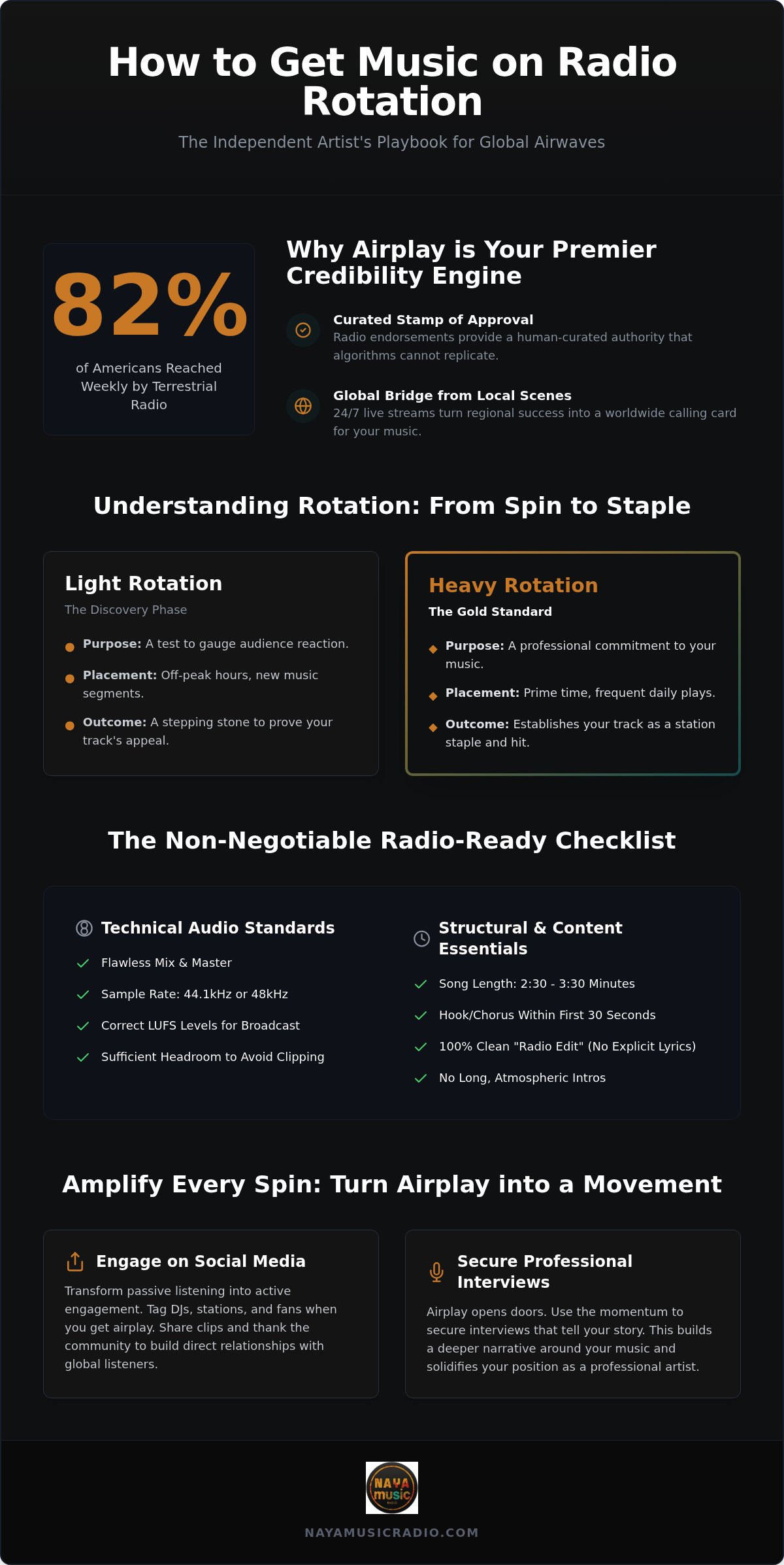
A single spin is often a test. It's a moment where a DJ or music director "takes the temperature" of the audience to see how they react to your sound. Rotation, however, is a professional commitment. It means the station has decided your track fits their vibe and their listeners' lives. There are levels to this game. Light rotation acts as a discovery tool, placing your track in off-peak hours or specialized new-music segments. Heavy Rotation is the gold standard for artist visibility. Stations monitor listener feedback, social tags, and engagement metrics to decide which tracks deserve more airtime. When you move from a single spin into a scheduled slot, you're transitioning from a guest to a staple of the station's identity.
Global Reach vs. Local Impact
Securing airplay in major music hubs like London, NYC, or Atlanta builds immediate regional authority. It gives you a "home base" that you can use as leverage for bigger opportunities. However, the power of modern radio lies in its ability to amplify that local buzz into a global movement. Through 24/7 live streaming and social media integration, your regional success becomes a worldwide calling card. This dual impact allows you to build a dedicated fanbase while maintaining the professional credibility that only radio can provide. You aren't just looking for a play; you're looking for a destination where your music can live and breathe. Master the art of how to get music on radio rotation and you turn your local sound into a global conversation.
Step 1: Preparing Your Track to be 'Radio-Ready'
Your song might be a creative masterpiece, but if it doesn't meet the technical standards of a modern broadcast booth, it'll never leave the submission pile. Understanding how to get music on radio rotation starts with the realization that your audio file is a professional product. Program directors look for tracks that slide seamlessly into their existing playlist without causing volume jumps or technical glitches. This means your mixing and mastering must be flawless. Aim for a sample rate of 44.1kHz or 48kHz and ensure your final master has enough headroom to avoid clipping during the FM or digital transmission process.
Structure is equally vital for the airwaves. Radio listeners have short attention spans and plenty of other stations to flip to. You need to ensure your hook or main chorus hits within the first 30 seconds to grab interest immediately. Additionally, you must create a dedicated "radio edit." This involves removing any explicit lyrics and optimizing the track length to sit between 2:30 and 3:30. Long, atmospheric intros might work for an album experience, but they are often the first thing a music director cuts. Professionalism here is non-negotiable.
The Studio Advantage
Capturing that elusive "commercial" sound is significantly easier when you move out of the bedroom and into a controlled environment. High-end preamps, industry-standard microphones, and acoustically treated rooms provide a level of clarity that software emulations can't always replicate. Using a recording studio rental UK gives you access to the same gear used by the artists currently topping the charts. Whether you're working out of our hubs in London, New York, or Atlanta, the goal is to produce a track that sounds expensive and polished. If you want to sound like a protagonist in the global music scene, you need to record like one. You can even submit your song for free once your studio session is complete to see if it's ready for the stage.
Metadata and Organization
A great song is useless if the station can't track who to pay or how to identify the artist. This is where metadata becomes your best friend. Every submission must include ISRC codes and proper ID3 tagging. These digital fingerprints ensure that every spin is logged correctly for royalty collection and performance tracking. You should also consult a Modern Guide to Radio Play to help you build a professional Electronic Press Kit (EPK). Your EPK should be a frictionless package containing your high-resolution artwork, a punchy bio, and direct contact details. When you make the station's job easier by being organized, you drastically increase your chances of seeing how to get music on radio rotation become a reality for your latest release.
Submission Strategies: DIY vs. Professional Promotion
Deciding how to bridge the gap between your hard drive and the airwaves is a defining moment in your career. You have two primary paths: the relentless hustle of DIY or the targeted investment of professional promotion. DIY strategies are the foundation of modern artist development. Many creators start by using per-pitch platforms like Groover or SubmitHub, where costs typically range from $0.80 to $4 per station pitch as of July 2026. While these portals offer a foot in the door, they require a high volume of submissions to see results. Cold emailing DJs is another option, but it demands a deep level of research to ensure your vibe matches their specific show. Without a personal connection, your pitch risks being lost in a crowded inbox.
Professional radio promoters, or "pluggers," offer a different level of momentum. These industry veterans have spent years building relationships with music directors in hubs like London and NYC. For independent artists, a six- to eight-week campaign from a full-service promoter typically starts between $1,800 and $2,400. If you are targeting college or non-commercial stations, costs usually range from $1,500 to $5,000. This is a significant investment, but it buys you the "in" that DIY often lacks. However, before spending your budget, you must ensure your track is truly ready for heavy rotation. Understanding how to get music on radio rotation means knowing when to trust your own hustle and when to call in the experts.
The NAYA way offers a middle ground designed for the modern creator. We believe participation should be frictionless and transparent. Instead of navigating complex gatekeepers, you can engage directly with our global platform. Our ecosystem is built to act as your global stage-builder, removing the technical barriers that often stall independent careers. We provide a home where your music isn't just a file; it's part of a shared cultural movement.
The Power of Free Song Submissions
We believe that talent should never be silenced by a lack of budget. Using a free song submission radio service allows you to test your sound on a global stage without financial risk. Our curators look for two things: authenticity and rhythm. They want tracks that feel "on the pulse" and resonate with a global audience. This direct path to airplay is the ultimate tool for artists who want to see how to get music on radio rotation works in a real-world, 24/7 streaming environment. It turns your submission into a celebration of new sound.
Avoiding the 'Pay-to-Play' Trap
Integrity is the currency of the music industry. You must stay vigilant against scams that promise "guaranteed" number ones or chart positions for a fee. On July 9, 2026, the FCC announced a major consent decree to address "showola," a practice where artists are pressured to perform for free in exchange for airplay. This update to payola rules serves as a reminder to focus on organic growth. Legitimate promotion is about building a community, not buying a playlist spot. Always prioritize platforms that champion emerging talent through transparent, service-oriented support rather than empty promises of instant fame.
Amplify Your Airplay: Social Media and Interviews
Securing that first spin is a massive win. It's a spark that needs oxygen to become a blaze. In the 2026 landscape, a radio play isn't the finish line; it's the start of a high-energy promotional cycle. Radio reaches 82% of Americans every week, and over 57% of listeners still use it for music discovery according to Soundcharts data. To capitalize on this reach, you must bridge the gap between the airwaves and your digital presence. Learning how to get music on radio rotation is as much about proving your fan engagement to station directors as it is about the quality of your master. When your track hits the air, the movement begins.
Social media is your primary tool for turning a single spin into a long-term commitment. Tag the station and the specific DJ in your stories and posts. This isn't just about politeness; it's about data. Stations track social mentions to see which artists are driving listener interaction. When you show a station that your fanbase is active and excited, you make it frictionless for them to move your track from a test spin into a scheduled slot. Use sensory descriptors and high-energy clips to let your followers feel the rhythm of the broadcast. You're not just sharing a link; you're inviting them to a global celebration of your sound.
Interviews are the secret weapon that transforms you from a faceless track into a relatable brand. While a song captures a mood, an interview captures a story. It provides the "why" behind the music, creating a deeper connection with international audiences in hubs like London, NYC, and Atlanta. This is the essence of social amplification. A ten-minute segment can be sliced into a week's worth of punchy reels, quotes, and behind-the-scenes content. By repurposing your airtime, you ensure your message resonates long after the broadcast ends.
The Artist Interview Strategy
Preparing for your first music interview promotion requires more than just showing up. You need to articulate your journey in a way that feels authentic and visionary. Focus on the cultural movements that inspire you and the local scenes that shaped your rhythm. This helps you connect with listeners across different time zones who are looking for the next big discovery. NAYA offers premium interview packages that include integrated social amplification, ensuring your story reaches every corner of our global network. We act as your stage-builder, providing the platform you need to shine.
Social Proof and Fan Requests
Credibility is built through consistency and community. Encourage your fans to send requests to the station via their official social channels. This organic "fan-pull" is a powerful signal to music directors that you belong in heavy rotation. Don't forget to share "On Air" clips of your track being played. These snippets act as professional social proof, showing other industry gatekeepers that you're already gaining momentum. It's time to take control of your narrative and turn every spin into a milestone. You can book your interview and social amplification today to start building your global legacy.
Conclusion: Launching Your Music on the Global Stage
The path from a local recording to global recognition is now yours to command. Throughout this playbook, we've broken down the essential pillars of modern airplay: achieving a professional sound, executing a strategic submission, and driving social amplification. Understanding how to get music on radio rotation is about more than just one lucky play; it's about positioning yourself as the protagonist of your own cultural movement. While your first spin is a massive milestone, remember that a single track is just the beginning. Building a catalog of high-quality, radio-ready music is what transforms a moment of visibility into a lifelong career. Consistency is the rhythm that keeps your audience engaged and your story moving forward.
We believe that every independent creator deserves a home where their talent is celebrated and their voice is heard. The era of distant industry gatekeepers is over. By embracing a professional, business-like approach to your promotion, you remove the friction that stalls so many emerging careers. You're not just an artist; you're a visionary building a destination for your fans. It's time to stop waiting for permission and start claiming your space on the global airwaves. Join the NAYA Music Radio family today and let's amplify your sound to the world.
Your 30-Day Radio Roadmap
Success in the music industry favors those with a clear, actionable plan. Follow this four-week guide to turn your latest track into a global conversation:
- Week 1: Finalize your radio-ready master. Use a professional studio in hubs like London, NYC, or Atlanta to ensure your audio meets the highest broadcast standards.
- Week 2: Submit your track via the NAYA frictionless portal. We've removed the traditional barriers to give your sound a direct path to our 24/7 live stream.
- Week 3: Book your interview. Tell the story behind the sound and use our social amplification tools to turn your airtime into a week of high-energy content.
- Week 4: Track your spins and engage. Monitor your progress, thank your new global fans, and use your radio credentials to build credibility with other industry leaders.
Take the First Step
The global stage is waiting for your unique rhythm. If you're ready to dive deeper into the mechanics of visibility, explore our music promotion tips for a comprehensive look at artist development. Your journey from the studio to the airwaves doesn't have to be a mystery. By mastering how to get music on radio rotation, you take control of your destiny as an independent creator. Submit your music for free today and start your 30-day roadmap to the top.
Claim Your Place in the Global Movement
Mastering the technical standards and professional submission strategies we've discussed is your first step toward true industry authority. You now have a clear roadmap to navigate the transition from a local recording to international airwaves. By focusing on a radio-ready sound and leveraging social amplification, you transform your music from a digital file into a shared cultural experience. We've removed the traditional gatekeepers to make your journey frictionless and transparent.
Learning how to get music on radio rotation is a journey of consistency and community building. You have the vision to turn a single spin into a global fanbase. With our 24/7 global live stream and physical studios in music hubs like London, NYC, and Atlanta, the infrastructure for your movement is already in place. We provide the home for emerging talent, offering free song submissions to ensure your voice is never silenced by a lack of budget.
Submit Your Music for Radio Rotation Today and join an ecosystem built to champion your creativity. Your sound is the heartbeat of the next global discovery. Let's build your stage together.
Frequently Asked Questions
How much does it cost to get a song on radio rotation?
Industry costs vary wildly based on your target and the level of support you need. Professional pluggers for national commercial campaigns can range from $10,000 to over $100,000; however, independent artists typically find success with college or community radio campaigns costing between $1,500 and $5,000. You can also utilize per-pitch platforms for just a few dollars per submission. We offer free song submissions to remove these financial barriers for emerging talent.
Can independent artists get on the radio without a label in 2026?
Absolutely. The modern music industry has shifted toward a DIY and hybrid model where curators value authenticity over major label backing. College and community stations are specifically designed to champion independent voices and local scenes. By mastering how to get music on radio rotation through professional production and strategic networking, you can build a global presence without a major contract.
What is the difference between internet radio and FM radio rotation?
The primary difference lies in royalty structures and global accessibility. In the U.S., terrestrial FM radio pays songwriters but doesn't pay performers; meanwhile, internet radio pays both via SoundExchange. Internet radio also offers a frictionless global reach, allowing listeners from any time zone to tune in 24/7. FM stations remain powerful for building regional authority in specific music hubs like London or NYC.
Do I need an ISRC code for radio airplay?
Yes, an ISRC code is essential for every track you submit for broadcast. This unique digital fingerprint allows stations to track your spins and ensures you receive the royalties you've earned. Without this code, your music can't be accurately logged by performance rights organizations. Always include your ISRC in your metadata and your submission's Electronic Press Kit (EPK).
How long does a song typically stay in radio rotation?
A standard rotation cycle usually lasts between two and twelve weeks. If your track gains significant traction and generates frequent listener requests, it can stay on a heavy rotation list much longer. Consistency is key to a long-term career. Launching a new track just as the previous one fades helps you maintain your momentum on the global stage.
What makes a song 'radio-ready' technically?
A radio-ready track requires professional mixing and mastering delivered in a high-quality 320kbps MP3 or WAV format. You must also provide a clean edit that removes any explicit language to comply with international broadcast regulations. Structurally, your song should be optimized for short attention spans, ensuring the main hook hits within the first 30 seconds of the audio.
How do I find radio stations that play my specific genre like Afrobeat?
Research global hubs where your genre is thriving, such as London, Atlanta, or DC. Look for stations with specialized shows that focus on emerging cultural movements rather than just the top 40 hits. You can use industry databases to see where similar artists are getting airplay. Targeting stations that already celebrate your specific rhythm increases your chances of securing a spot in their rotation.
What should I include in my radio submission email?
Your submission email should be punchy, professional, and frictionless for the music director. Include a direct link to your radio-ready WAV file, high-resolution artwork, and a brief bio that highlights your unique journey. Don't forget to attach your EPK and clear contact information. Making the station's job easier is a proven strategy for how to get music on radio rotation in a competitive market.


